CrispyWaffle.Redis
CrispyWaffle.Redis connects CrispyWaffle to Redis. It has four parts:
- A cache repository for
CacheManager. - A log provider that publishes log messages to Redis Pub/Sub channels.
- A telemetry client that stores hits, events and metrics in Redis.
- Helpers for master/replica setups and quick counter operations.
Use it when several processes or machines need a shared cache, when you want log messages streamed to listeners in real time, or when you want lightweight counters stored in Redis.
| Package | CrispyWaffle.Redis |
| Namespace | CrispyWaffle.Redis.Cache, CrispyWaffle.Redis.Log, CrispyWaffle.Redis.Log.PropagationStrategy, CrispyWaffle.Redis.Telemetry, CrispyWaffle.Redis.Utils, CrispyWaffle.Redis.Utils.Communications |
| Install | dotnet add package CrispyWaffle.Redis |
| Depends on | CrispyWaffle, CrispyWaffle.Configuration, StackExchange.Redis, StackExchange.Redis.Extensions.Core |
How it works
The connector
Everything in this package goes through a RedisConnector. The connector builds a StackExchange.Redis.Extensions RedisConfiguration with these settings:
AbortOnConnectFail = falseandAllowAdmin = true.- A server enumeration strategy of
Allservers,Anyrole, andThrowon unreachable servers. - A host list parsed from a comma-separated string of
host[:port]entries. The port defaults to6379when it's missing.
From that configuration, the connector creates a RedisConnectionPoolManager and a RedisClient.
Every connector needs an ISerializer from StackExchange.Redis.Extensions.Core. That serializer converts cached values to and from bytes. The package doesn't include an implementation, so either reference a serializer package such as StackExchange.Redis.Extensions.System.Text.Json or write your own (see Getting started).
You can create a connector in several ways:
- From an
IConnection(Host,PortandCredentials.Passwordare used; the username is ignored). - From a host and a port.
- From a raw host list.
- From a
MasterSlaveConfiguration, which combines two connections. - From an existing
IRedisClientandIRedisConnectionPoolManager.
Register the connector as a singleton, because it owns the connection pool.
QueuePrefix defaults to "crispy-waffle". The Pub/Sub log provider uses it to name channels. The overloads that take a queuePrefix throw ArgumentNullException when it's null.
Cache repository
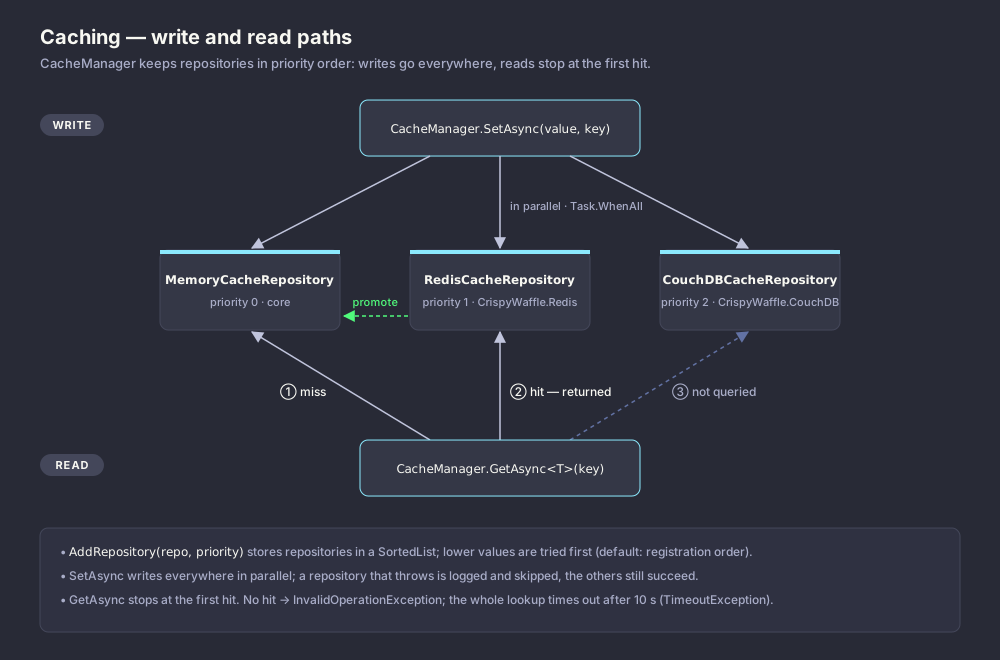
RedisCacheRepository implements ICacheRepository, so you can add it to CacheManager alongside other repositories.
- The
ICacheRepositorymethods always use database 0 (IRedisClient.Db0) and the connector's serializer. - Sub-key entries are stored as Redis hashes.
SetAsync(value, key, subKey)reads the whole hash, sets one field, and writes the hash back withFireAndForget. SetToDatabase,GetFromDatabase,TryGetFromDatabaseandRemoveFromDatabasework with any database number and call the connector serializer directly.
Errors depend on ShouldPropagateExceptions, which defaults to false:
- When it's
false, failures are logged instead of thrown. Exceptions whose message contains "timeout" go toLogConsumer.Trace; all others go toLogConsumer.Handle. OperationCanceledExceptionand argument-validation exceptions are always rethrown.GetAsyncthrowsInvalidOperationExceptionwhen the key is missing. It also throwsInvalidOperationExceptionafter logging a suppressed error, so a missing key and a failed call look the same to the caller.- The
TryGetAsyncoverloads return(false, default)in both of those cases instead.
Dispose() disposes the underlying RedisConnector. If several components share one connector, don't dispose the repository until all of them are done.
Pub/Sub log provider
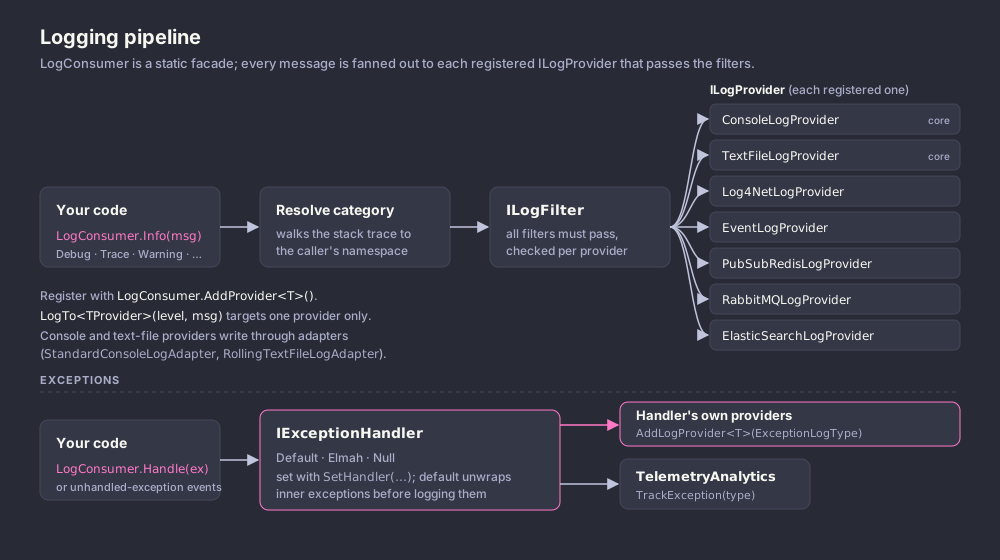
PubSubRedisLogProvider is an ILogProvider. Each logging call that passes the level check builds a LogMessage, serializes it to JSON, and adds it to an in-memory ConcurrentQueue<string>. The LogMessage carries:
- The date, host name and process ID.
- The local and remote IP addresses.
- The operation, user agent, thread ID and thread name.
- A new GUID as the message
Id.
The constructor starts a dedicated worker thread named "Message queue Redis log provider worker". The thread waits one second and then loops. Each pass drains the queue and hands every message to the configured IPropagationStrategy. When the queue is empty and the CancellationToken passed to the constructor has been cancelled, the worker exits.
The worker is a foreground thread and doesn't sleep between passes. Cancel the token when your application shuts down, or the thread keeps the process alive.
If publishing a message throws, the worker logs the exception through LogConsumer.Debug and moves on to the next message.
The provider's log level starts at no levels, so it records nothing until you call SetLevel.
Each propagation strategy publishes two messages:
- The queue name to the channel
{QueuePrefix}-queues, so listeners can discover which channels are active. - The serialized log message to
{QueuePrefix}-{queue name}.
| Strategy | Queue name |
|---|---|
GeneralPropagation |
general |
OperationPropagationStrategy |
EnvironmentHelper.Operation (set with EnvironmentHelper.SetOperation) |
ProcessPropagation |
EnvironmentHelper.ProcessId |
Telemetry client
RedisTelemetryClient implements ITelemetryClient:
- Hits are string counters in database
HitDatabase. - Metrics are hash counters in database
MetricDatabase, with one hash per metric and one field per variation. - Events are serialized strings stored in the database whose number is the event's
Category, under the event'sName. - Exceptions and dependencies are counted in the hashes
Exceptions_{suffix}andDependencies_{suffix}inMetricDatabase.
Writes use CommandFlags.FireAndForget, and reads use CommandFlags.PreferReplica.
Getting started
Start Redis locally. The repository's docker-compose.yml runs redis:6.2-alpine on port 6379 with the password myP@ssw0rd.
Then create a serializer, a connection and a connector, and register them:
using System.Text.Json;
using System.Threading;
using CrispyWaffle.Cache;
using CrispyWaffle.Composition;
using CrispyWaffle.Configuration;
using CrispyWaffle.Log;
using CrispyWaffle.Redis.Cache;
using CrispyWaffle.Redis.Log;
using CrispyWaffle.Redis.Log.PropagationStrategy;
using CrispyWaffle.Redis.Telemetry;
using CrispyWaffle.Redis.Utils.Communications;
using CrispyWaffle.Telemetry;
using StackExchange.Redis.Extensions.Core;

public sealed class SystemTextJsonRedisSerializer : ISerializer
{
    private readonly JsonSerializerOptions _options = new(JsonSerializerDefaults.Web);

    public byte[] Serialize<T>(T item) => JsonSerializer.SerializeToUtf8Bytes(item, _options);

    public T Deserialize<T>(byte[] serializedObject) =>
        JsonSerializer.Deserialize<T>(serializedObject, _options);
}

public static class RedisBootstrap
{
    public static void Configure(CancellationToken shutdownToken)
    {
        var connection = new Connection
        {
            Host = "localhost",
            Port = 6379,
            Credentials = { Password = "myP@ssw0rd" },
        };

        var connector = new RedisConnector(
            connection,
            new SystemTextJsonRedisSerializer(),
            "my-app"
        );

        // One connector per process: it owns the connection pool.
        ServiceLocator.Register(connector);

        // Cache
        CacheManager.AddRepository(new RedisCacheRepository(connector));

        // Logging
        LogConsumer
            .AddProvider(
                new PubSubRedisLogProvider(connector, new GeneralPropagation(), shutdownToken)
            )
            .SetLevel(LogLevel.Production);

        // Telemetry
        TelemetryAnalytics.AddClient(new RedisTelemetryClient(connector, "my-app"));
    }
}
After that, await CacheManager.SetAsync("value", "my-key"), LogConsumer.Info("...") and TelemetryAnalytics.TrackHit("home") all reach Redis.
Reference
RedisConnector
public class RedisConnector : IDisposable owns the Redis connection pool and the IRedisClient that every other type in this package uses. It has the [ConnectionName("Redis")] attribute.
| Member | Description |
|---|---|
RedisConnector(IConnection connection, ISerializer serializer) / RedisConnector(IConnection connection, ISerializer serializer, string queuePrefix) |
Connects to connection.Host:connection.Port with connection.Credentials.Password. The queuePrefix overload throws ArgumentNullException when queuePrefix is null. |
RedisConnector(string host, int port, string password, ISerializer serializer) / RedisConnector(string host, int port, string password, ISerializer serializer, string queuePrefix) |
Connects to a single host and port. |
RedisConnector(string hostsList, string password, ISerializer serializer) / RedisConnector(string hostsList, string password, ISerializer serializer, string queuePrefix) |
Connects to a comma-separated list of host[:port] entries (default port 6379). All other constructors except the IRedisClient one end up here. |
RedisConnector(MasterSlaveConfiguration configuration, ISerializer serializer) / RedisConnector(MasterSlaveConfiguration configuration, ISerializer serializer, string queuePrefix) |
Connects using configuration.HostsList and configuration.Password. |
RedisConnector(IRedisClient client, IRedisConnectionPoolManager connectionPoolManager, ISerializer serializer, string queuePrefix) |
Wraps an existing client and pool manager, for example in tests or when you configure StackExchange.Redis.Extensions yourself. queuePrefix isn't validated. |
Serializer |
The ISerializer passed to the constructor. |
Cache |
The IRedisClient (StackExchange.Redis.Extensions) used by RedisCacheRepository. |
Subscriber |
An ISubscriber from a pooled connection. Used to publish and subscribe to channels. |
DefaultDatabase |
The default IDatabase of a pooled connection. |
QueuePrefix |
Prefix for Pub/Sub channel names. Defaults to "crispy-waffle". |
GetDatabase(int databaseNumber, object asyncState = null) |
Returns the IDatabase with the given number from a pooled connection. |
GetDefaultServer() |
Returns the IServer for the first configured endpoint. |
Dispose() |
Disposes the connection pool manager. Calling it again has no effect. |
RedisCacheRepository
public class RedisCacheRepository : ICacheRepository, IDisposable is a cache repository backed by Redis. It reads and writes database 0, except for the *Database methods.
| Member | Description |
|---|---|
RedisCacheRepository(RedisConnector connector) |
Constructor. Uses connector.Cache for the ICacheRepository operations. |
ShouldPropagateExceptions |
When true, Redis errors are rethrown. When false (default), they are logged and suppressed. |
SetAsync<T>(T value, string key, TimeSpan? ttl = null, CancellationToken cancellationToken = default) |
Stores value under key, with an optional expiry. When the token can be canceled, it waits for the write or the cancellation, whichever comes first, and throws OperationCanceledException on cancellation. Returns ValueTask. |
SetAsync<T>(T value, string key, string subKey, CancellationToken cancellationToken = default) |
Stores value as field subKey of the hash key. Throws ArgumentException when key or subKey is null or empty, and ArgumentNullException when value is null for a reference type. Returns ValueTask. |
GetAsync<T>(string key, CancellationToken cancellationToken = default) |
Returns the value stored under key. Throws ArgumentException for an empty key, and InvalidOperationException ("Unable to get the item with key ...") when the key doesn't exist or a suppressed error occurred. Returns ValueTask<T>. |
GetAsync<T>(string key, string subKey, CancellationToken cancellationToken = default) |
Currently ignores subKey and behaves like GetAsync<T>(key). Because sub-key values are stored as hashes, reading them this way fails. Use TryGetAsync<T>(key, subKey) to read a hash field. |
TryGetAsync<T>(string key, CancellationToken cancellationToken = default) |
Returns (true, value) when key exists. Returns (false, default) when it doesn't, or when an error is suppressed. Throws ArgumentException for an empty key. |
TryGetAsync<T>(string key, string subKey, CancellationToken cancellationToken = default) |
Returns (true, value) when the hash field subKey exists in key. Otherwise returns (false, default). |
RemoveAsync(string key, CancellationToken cancellationToken = default) |
Deletes key with FireAndForget. Returns Task. |
RemoveAsync(string key, string subKey, CancellationToken cancellationToken = default) |
Deletes the hash field subKey from key with FireAndForget. The token isn't checked. |
TTLAsync(string key, CancellationToken cancellationToken = default) |
Returns the remaining time to live of key, or TimeSpan.Zero when the key doesn't exist, has no expiry, or an error is suppressed. |
Clear() |
Flushes database 0 (FLUSHDB). Returns Task. |
SetToDatabase<T>(T value, string key, int databaseNumber, TimeSpan? ttl = null, bool fireAndForget = false) |
Synchronously serializes value with the connector serializer and stores it under key in the given database. |
GetFromDatabase<T>(string key, int databaseNumber) |
Synchronously reads and deserializes key from the given database. Throws InvalidOperationException when the key doesn't exist. |
TryGetFromDatabase<T>(string key, int databaseNumber, out T value) |
Synchronous try-get from the given database. Returns false when the key doesn't exist. |
RemoveFromDatabase(string key, int databaseNumber) |
Synchronously deletes key from the given database. |
Dispose() |
Disposes the RedisConnector passed to the constructor. |
PubSubRedisLogProvider
public class PubSubRedisLogProvider : ILogProvider queues log messages and publishes them to Redis Pub/Sub channels from a background thread.
| Member | Description |
|---|---|
PubSubRedisLogProvider(RedisConnector redis, IPropagationStrategy propagationStrategy, CancellationToken cancellationToken) |
Constructor. Starts the worker thread. The worker stops after cancellationToken is canceled and the queue is empty. |
SetLevel(LogLevel level) |
Sets which levels are published. The initial value has no flags set, so nothing is published until this is called. |
Fatal(category, message) / Error(category, message) / Warning(category, message) / Info(category, message) / Debug(category, message) |
Queues a message at that level when the level is enabled. |
Trace(category, message) / Trace(category, message, exception) / Trace(category, exception) |
Queues a trace message. The exception overloads also queue the message and the stack trace of the exception and of each inner exception, as separate messages. |
Debug(string category, string content, string identifier) |
Queues content at debug level with identifier as the MessageIdentifier. |
Debug<T>(string category, T content, string identifier, SerializerFormat customFormat = SerializerFormat.None) |
Serializes content with its default serializer (when customFormat is None) or with customFormat, and queues it at debug level. T must be class, new(). |
IPropagationStrategy
public interface IPropagationStrategy decides which Redis channel a log message is published to. Implement it to route messages differently.
| Member | Description |
|---|---|
Propagate(string message, string queuePrefix, ISubscriber publisher) |
Publishes message synchronously. PubSubRedisLogProvider calls this method. |
PropagateAsync(string message, string queuePrefix, ISubscriber publisher, CancellationToken cancellationToken) |
Publishes message asynchronously. The built-in strategies return without publishing when cancellationToken is already canceled. |
GeneralPropagation
public sealed class GeneralPropagation : IPropagationStrategy publishes every message to one shared channel. The class is in the file GeneralPropagationStrategy.cs.
| Member | Description |
|---|---|
Propagate(message, queuePrefix, publisher) / PropagateAsync(message, queuePrefix, publisher, cancellationToken) |
Publishes "general" to {queuePrefix}-queues, then message to {queuePrefix}-general. |
OperationPropagationStrategy
public sealed class OperationPropagationStrategy : IPropagationStrategy publishes messages to a channel named after the current operation.
| Member | Description |
|---|---|
Propagate(message, queuePrefix, publisher) / PropagateAsync(message, queuePrefix, publisher, cancellationToken) |
Publishes EnvironmentHelper.Operation to {queuePrefix}-queues, then message to {queuePrefix}-{EnvironmentHelper.Operation}. |
ProcessPropagation
public sealed class ProcessPropagation : IPropagationStrategy publishes messages to a channel named after the current process ID. The class is in the file ProcessPropagationStrategy.cs.
| Member | Description |
|---|---|
Propagate(message, queuePrefix, publisher) / PropagateAsync(message, queuePrefix, publisher, cancellationToken) |
Publishes EnvironmentHelper.ProcessId to {queuePrefix}-queues, then message to {queuePrefix}-{EnvironmentHelper.ProcessId}. |
RedisTelemetryClient
public sealed class RedisTelemetryClient : ITelemetryClient stores telemetry counters and events in Redis.
| Member | Description |
|---|---|
RedisTelemetryClient() |
Resolves RedisConnector from ServiceLocator and sets the default event TTL to 30 days. The key suffix is null, so the exception and dependency hashes are named Exceptions_ and Dependencies_. |
RedisTelemetryClient(RedisConnector redis, string suffix) |
Uses the given connector and key suffix. The default event TTL isn't set by this constructor and stays at TimeSpan.Zero, so prefer TrackEvent(event, ttl) with this constructor. |
HitDatabase |
Database number for hit counters. Defaults to 0. |
MetricDatabase |
Database number for metrics, exceptions and dependencies. Defaults to 0. |
TrackHit(string hitName) |
Increments the counter hitName by 1. |
GetHit(string hitName) |
Returns the counter hitName, or 0 when it doesn't exist. |
RemoveHit(string hitName) |
Deletes the counter hitName. Returns true when it was deleted. |
TrackEvent<TEvent>(ITelemetryEvent<TEvent> @event) / TrackEvent<TEvent>(ITelemetryEvent<TEvent> @event, TimeSpan ttl) |
Serializes @event.Event and stores it under @event.Name in database @event.Category, with the default TTL or ttl. |
GetEvent<TEvent>(ITelemetryEvent<TEvent> @event) |
Reads @event.Name from database @event.Category and deserializes it with the connector serializer. Returns null when the key doesn't exist. |
TrackMetric(string metricName, string variation) |
Increments field variation of hash metricName by 1. |
GetMetric(string metricName, string variation) |
Returns field variation of hash metricName, or 0. |
RemoveMetric(string metricName, string variation) |
Deletes field variation from hash metricName. Returns true when it was deleted. |
TrackException(Type exceptionType) |
Increments field exceptionType.FullName of hash Exceptions_{suffix}. |
TrackDependency(Type interfaceType, int resolvedTimes) |
Increments field interfaceType.FullName of hash Dependencies_{suffix} by resolvedTimes. |
MasterSlaveConfiguration
public sealed class MasterSlaveConfiguration combines a primary connection and a replica connection into one host list for RedisConnector. It has [ConnectionName("RedisMaster", Order = 0)] and [ConnectionName("RedisSlave", Order = 1)].
| Member | Description |
|---|---|
MasterSlaveConfiguration(IConnection master, IConnection slave) |
Builds HostsList and Password. Throws ArgumentNullException when either argument is null. |
HostsList |
"{master.Host}:{master.Port},{slave.Host}:{slave.Port}". |
Password |
The master's password, or the replica's password when the master's is null. |
RedisExtensions
public static class RedisExtensions has shortcuts that run against the RedisConnector registered in ServiceLocator.
The connector is resolved once, when the class is first used. Register RedisConnector before you call any of these methods.
| Member | Description |
|---|---|
TemporaryIncrease(string cacheKey, TimeSpan ttl) |
Increments cacheKey in the default database, sets its expiry to ttl (both fire-and-forget), and returns the current value. Useful for rate limiting. |
FlushDatabase(int database) |
Flushes database number database on the first configured server. |
Examples
Register through the service locator
Register the connector and repository as singletons, then let CacheManager resolve the repository.
using CrispyWaffle.Cache;
using CrispyWaffle.Composition;
using CrispyWaffle.Configuration;
using CrispyWaffle.Redis.Cache;
using CrispyWaffle.Redis.Utils.Communications;

ServiceLocator.Register(
    () =>
        new RedisConnector(
            new Connection
            {
                Host = "localhost",
                Port = 6379,
                Credentials = { Password = "myP@ssw0rd" },
            },
            new SystemTextJsonRedisSerializer()
        ),
    Lifetime.Singleton
);

ServiceLocator.Register(
    () => new RedisCacheRepository(ServiceLocator.Resolve<RedisConnector>()),
    Lifetime.Singleton
);

CacheManager.AddRepository<RedisCacheRepository>();
Store and read sub-keys
var repository = ServiceLocator.Resolve<RedisCacheRepository>();

await repository.SetAsync("Alice", "user:42", "name");
await repository.SetAsync("alice@example.com", "user:42", "email");

var (found, name) = await repository.TryGetAsync<string>("user:42", "name");
Connect to a primary and a replica
using CrispyWaffle.Configuration;
using CrispyWaffle.Redis.Utils;
using CrispyWaffle.Redis.Utils.Communications;

var master = new Connection { Host = "redis-primary", Port = 6379, Credentials = { Password = "secret" } };
var slave = new Connection { Host = "redis-replica", Port = 6379 };

var connector = new RedisConnector(
    new MasterSlaveConfiguration(master, slave),
    new SystemTextJsonRedisSerializer()
);
Listen to log messages from another process
The GeneralPropagation strategy publishes to {QueuePrefix}-general. Any Redis client can subscribe to that channel.
using StackExchange.Redis;

connector.Subscriber.Subscribe(
    RedisChannel.Literal($"{connector.QueuePrefix}-general"),
    (channel, message) => Console.WriteLine(message)
);
Track a telemetry event
using CrispyWaffle.Telemetry;

public sealed class CheckoutEvent : ITelemetryEvent<CheckoutData>
{
    public string Name => "checkout:last";

    public int Category => 2; // Redis database number

    public CheckoutData Event { get; init; }
}

public sealed class CheckoutData
{
    public decimal Total { get; set; }
}

TelemetryAnalytics.TrackEvent(new CheckoutEvent { Event = new CheckoutData { Total = 99.90m } }, TimeSpan.FromDays(7));
Rate-limit with a temporary counter
using CrispyWaffle.Redis.Utils;

var calls = RedisExtensions.TemporaryIncrease($"rate:{clientId}", TimeSpan.FromMinutes(1));
if (calls > 100)
{
    throw new InvalidOperationException("Too many requests.");
}