CrispyWaffle.EventLog
CrispyWaffle.EventLog writes CrispyWaffle log messages to the Windows Event Log. Use it for Windows services and desktop applications whose operators read logs in Event Viewer.
The package uses System.Diagnostics.EventLog, which only works on Windows. The library targets .NET Standard and .NET and has no platform annotation, so it builds anywhere, but on Linux and macOS the System.Diagnostics.EventLog calls throw PlatformNotSupportedException.
| Package | CrispyWaffle.EventLog |
| Namespace | CrispyWaffle.EventLog.Log.Providers, CrispyWaffle.EventLog.Log.Adapters |
| Install | dotnet add package CrispyWaffle.EventLog |
| Depends on | CrispyWaffle, System.Diagnostics.EventLog |
How it works
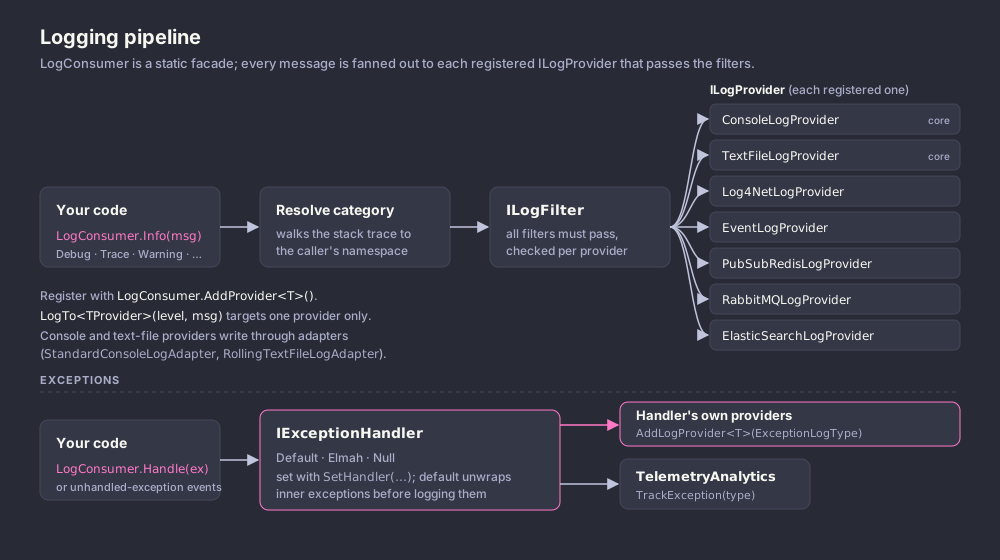
EventLogProvider is the ILogProvider you register with LogConsumer. It forwards every call to an EventLogAdapter, which writes entries to a System.Diagnostics.EventLog. The category argument is not used.
Log and source. The adapter writes to the log named by logName, or to Application when logName is null, empty or whitespace. The source name is cut to 212 characters and < and > are replaced by _.
Source registration. Creating an event source requires administrator rights. By default (manageEventSource: false) the adapter only sets the source name; register the source beforehand, for example during installation with EventLog.CreateEventSource. With manageEventSource: true the adapter creates the source when it does not exist. If the source exists in a different log, the adapter deletes it from that log and writes a warning entry, under a helper source named serilog-{logName}, saying that a restart may be required before entries appear in the new log.
Levels and entry types. The adapter starts with no level enabled; call SetLevel after you register the provider. Levels map to entry types as follows:
LogLevel |
EventLogEntryType |
|---|---|
Fatal, Error |
Error |
Warning |
Warning |
Info, Trace, Debug |
Information |
Message size. Messages longer than 31,839 characters are truncated. Exceptions are written as one entry that contains the message and stack trace of the exception and of each inner exception, separated by \r\n.
Event IDs. Each entry gets an event ID from an IEventIdProvider. The default EventIdProvider hashes the message text into a 16-bit number, so the same message always gets the same ID.
Getting started
using CrispyWaffle.EventLog.Log.Providers;
using CrispyWaffle.Log;

LogConsumer.AddProvider(new EventLogProvider("my-service")).SetLevel(LogLevel.Production);

LogConsumer.Info("Service started");
Reference
EventLogProvider
public sealed class EventLogProvider : ILogProvider — log provider that writes to the Windows Event Log through an EventLogAdapter.
| Member | Description |
|---|---|
EventLogProvider() |
Constructor. Uses source crispy-waffle, the Application log, the local machine, no source management, and EventIdProvider. |
EventLogProvider(string source) |
Constructor. Uses source, the Application log, the local machine, no source management, and EventIdProvider. |
EventLogProvider(string source, string logName) |
Constructor. Same as above with the given log name. |
EventLogProvider(string source, string logName, string machineName, bool manageEventSource, IEventIdProvider eventIdProvider) |
Constructor. Uses EventIdProvider when eventIdProvider is null. Throws ArgumentNullException when source is null. |
SetLevel(LogLevel level) |
Sets the enabled levels on the adapter. |
Fatal(category, message) / Error(category, message) / Warning(category, message) / Info(category, message) |
Writes message at that level. |
Trace(category, message) |
Writes message at trace level. |
Trace(category, message, exception) |
Writes message, then the exception details, as two entries at trace level. |
Trace(category, exception) |
Writes the exception details as one entry at trace level. |
Debug(category, message) |
Writes message at debug level. |
Debug(category, content, identifier) |
Writes "{identifier}: {content}" at debug level. |
Debug<T>(string category, T content, string identifier, SerializerFormat customFormat = SerializerFormat.None) |
Serializes content with its [Serializer] format (or with customFormat when it is not None) and writes "{identifier}: {serialized}" at debug level. T must be class, new(). |
IEventIdProvider
public interface IEventIdProvider — computes the event ID for a log entry. Implement it to control event IDs, for example to map known messages to fixed IDs.
| Member | Description |
|---|---|
ushort ComputeEventId(string message) |
Returns the event ID for message. |
EventIdProvider
public class EventIdProvider : IEventIdProvider — default implementation that hashes the message.
| Member | Description |
|---|---|
ComputeEventId(string message) |
Returns a 16-bit hash of message (a Jenkins one-at-a-time hash truncated to ushort). Throws ArgumentNullException when message is null. |
EventLogAdapter
public sealed class EventLogAdapter : ILogAdapter — writes to a System.Diagnostics.EventLog. EventLogProvider creates one internally; use it directly only if you build your own provider.
| Member | Description |
|---|---|
EventLogAdapter(string source, string logName, string machineName, bool manageEventSource, IEventIdProvider eventIdProvider) |
Constructor. Normalizes the source name, opens the log (Application when logName is null or whitespace) and either registers the source (manageEventSource: true) or only sets it. Throws ArgumentNullException when source or eventIdProvider is null. |
SetLevel(LogLevel level) |
Sets the enabled levels. |
Fatal(message) / Error(message) / Warning(message) / Info(message) |
Writes message at that level. |
Trace(message) |
Writes message at trace level. |
Trace(message, exception) |
Writes message, then the exception details, as two entries at trace level. |
Trace(exception) |
Writes the exception details as one entry at trace level. |
Debug(message) |
Writes message at debug level. |
Debug(string content, string fileName) |
Writes "{fileName}: {content}" at debug level. |
Debug<T>(T content, string identifier, SerializerFormat customFormat = SerializerFormat.None) |
Serializes content and writes "{identifier}: {serialized}" at debug level. T must be a class. |
Dispose() |
Does nothing. The underlying EventLog is not disposed. |
Examples
Write to a custom log with source management
Run once with administrator rights so the source can be created in the MyCompany log.
using System;
using CrispyWaffle.EventLog.Log.Providers;
using CrispyWaffle.Log;

var provider = new EventLogProvider(
    "billing-service",
    "MyCompany",
    Environment.MachineName,
    manageEventSource: true,
    eventIdProvider: null
);

LogConsumer.AddProvider(provider).SetLevel(LogLevel.All);

LogConsumer.Warning("Invoice queue is above {0} items", 1000);
Use fixed event IDs
Return the same event ID for every entry from a source.
using System;
using CrispyWaffle.EventLog.Log.Providers;

var provider = new EventLogProvider(
    "billing-service",
    "Application",
    Environment.MachineName,
    false,
    new FixedEventIdProvider()
);

public sealed class FixedEventIdProvider : IEventIdProvider
{
    public ushort ComputeEventId(string message) => 1000;
}