Logging
CrispyWaffle logging is a static facade, LogConsumer, that fans each message out to every registered log provider. Providers decide where messages go (console, rolling text files, Log4Net, Redis, RabbitMQ, Elasticsearch, Windows Event Log). Filters decide which provider receives which message, and an exception handler decides what happens to exceptions passed to LogConsumer.Handle.
Use it when you want one logging call site in your code and the freedom to add or swap destinations at startup without touching that code.
| Package | CrispyWaffle |
| Namespace | CrispyWaffle.Log, CrispyWaffle.Log.Adapters, CrispyWaffle.Log.Filters, CrispyWaffle.Log.Handlers, CrispyWaffle.Log.Providers |
How it works
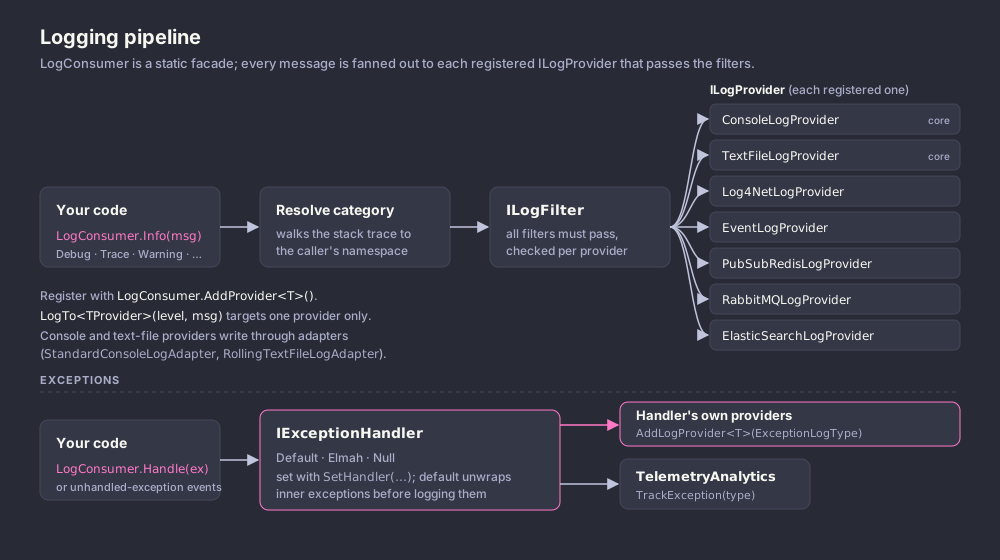
The pipeline has four kinds of parts:
LogConsumeris the static entry point. It holds a list of providers, a list of filters and one exception handler.- Providers (
ILogProvider) receive a category and a message for each level. You register them withLogConsumer.AddProvider. - Adapters (
ILogAdapterand friends) do the actual writing for the two core providers.ConsoleLogProviderwrites through anIConsoleLogAdapterandTextFileLogProviderwrites through anITextFileLogAdapter, both resolved from the service locator. - Filters (
ILogFilter) are checked per provider, per message.
Sending a message
When you call LogConsumer.Info("...") (or any other level), the consumer:
- Resolves a category by walking the stack trace. It skips frames whose declaring type is in
CrispyWaffle.Log*or is a CrispyWaffle type whose name ends withLogProvider, then uses the declaring type's full name (for exampleMyApp.Services.OrderService). A leadingCrispyWaffle.prefix is removed. For async methods and lambdas this is the compiler-generated type name (for exampleMyApp.OrderService+<RunAsync>d__0). If no frame qualifies, the category isCrispyWaffle. - For each provider, calls every registered filter with the provider's full type name, the level, the category and the message. The provider receives the message only if all filters return
true. - Calls the matching method on each provider that passed, synchronously and in registration order.
LogTo<TLogProvider> and DebugTo<TLogProvider> skip the fan-out and target the one registered provider whose runtime type is exactly TLogProvider. They return false when no such provider is registered or a filter rejects the message.
The overloads that take params object[] arguments format the message with string.Format(CultureInfo.InvariantCulture, ...) before it reaches the providers.
Levels
LogLevel is a [Flags] enum. Each provider (through its adapter) keeps its own level and drops messages whose level flag is not set. LogConsumer itself does not check levels. The built-in adapters start at LogLevel.Production (Fatal, Error, Warning, Info), so Trace and Debug messages are dropped until you call SetLevel on the provider:
LogConsumer.AddProvider<ConsoleLogProvider>().SetLevel(LogLevel.All);
Exceptions
LogConsumer.Handle(exception) (and the two event-handler overloads) forward to the current IExceptionHandler. The handler is chosen the first time LogConsumer is used (static constructor): it resolves IExceptionHandler from the service locator and, if that fails, falls back to DefaultExceptionHandler and passes it the resolution error. Without a registration, resolution normally fails because the core package already contains two implementations (DefaultExceptionHandler and NullExceptionHandler) and auto-registration refuses to pick one. Register your handler before the first logging call, or replace it later with LogConsumer.SetHandler.
DefaultExceptionHandler does not write to the providers registered on LogConsumer. It keeps its own static list of providers, added with AddLogProvider<T>(ExceptionLogType), TryAddConsoleLogProvider() or TryAddTextFileLogProvider(). When it handles an exception it:
- Resolves a category from the stack trace, the same way
LogConsumerdoes. - Unwraps the exception chain (innermost first) and calls
TelemetryAnalytics.TrackExceptionfor each inner exception type (see Telemetry). - Calls
Error(category, message)on eachExceptionLogType.Messageprovider once per exception in the chain, with just that exception'sMessage. - Calls
Error(category, details)once on eachExceptionLogType.Fullprovider, wheredetailscontains every exception's message, type name and stack trace, withException rethrow at [n]:markers between them.
With no providers added, DefaultExceptionHandler only tracks telemetry.
Integration packages
Other CrispyWaffle packages add providers and handlers that plug into the same pipeline:
| Package | Adds |
|---|---|
| Log4Net | Log4NetLogProvider |
| EventLog | EventLogProvider, EventLogAdapter |
| Redis | PubSubRedisLogProvider |
| RabbitMQ | RabbitMQLogProvider |
| Elasticsearch | ElasticSearchLogProvider |
| Elmah | ElmahExceptionHandler |
Threading
LogConsumer holds providers and filters in plain collections with no locking, so register them at startup before logging from multiple threads. StandardConsoleLogAdapter and RollingTextFileLogAdapter lock around each write, so concurrent logging through them is safe.
Getting started
Register an adapter and an exception handler, add a provider, then log.
using System;
using CrispyWaffle.Composition;
using CrispyWaffle.Log;
using CrispyWaffle.Log.Adapters;
using CrispyWaffle.Log.Handlers;
using CrispyWaffle.Log.Providers;

public static class Program
{
    public static void Main()
    {
        // Adapter used by ConsoleLogProvider.
        ServiceLocator.Register<IConsoleLogAdapter, StandardConsoleLogAdapter>(Lifetime.Singleton);

        // Must be registered before the first LogConsumer call.
        ServiceLocator.Register<IExceptionHandler, NullExceptionHandler>(Lifetime.Singleton);

        LogConsumer.AddProvider<ConsoleLogProvider>().SetLevel(LogLevel.All);

        LogConsumer.Info("Hello world Crispy Waffle");
        LogConsumer.Debug("Current time: {0:HH:mm:ss}", DateTime.Now);
        LogConsumer.Warning("Press any key to close the program!");

        Console.ReadKey();
    }
}
Reference
LogConsumer
public static class LogConsumer — static facade that sends messages to every registered provider and exceptions to the exception handler.
Methods without a To suffix return void and write to every provider that passes the filters. The category is resolved from the caller; see How it works.
| Member | Description |
|---|---|
StorageDirectory |
public static readonly string. <AppDomain base directory>/Logs. Set by the static constructor; not used by the core library. |
DebugDirectory |
public static readonly string. StorageDirectory/Debug. Not used by the core library. |
AddProvider<TLogProvider>() |
Resolves TLogProvider from ServiceLocator, adds it and returns it as ILogProvider. Constraint: TLogProvider : ILogProvider. |
AddProvider(ILogProvider provider) |
Adds an existing provider instance and returns it. |
AddFilter(ILogFilter filter) |
Adds a filter. Every filter must return true for a provider to receive a message. |
SetHandler(IExceptionHandler handler) |
Replaces the exception handler used by Handle. |
LogTo<TLogProvider>(LogLevel level, string message) |
Logs to the single registered provider whose type is exactly TLogProvider. Returns false if none is registered or a filter rejects it. Throws InvalidOperationException if more than one provider of that type is registered, and ArgumentOutOfRangeException if level is a combined value such as Production. |
DebugTo<TLogProvider>(string content, string identifier) |
Sends content with an identifier at Debug level to one provider (ILogProvider.Debug(category, content, identifier)). Same return rules as LogTo. |
DebugTo<TLogProvider, T>(T content, string identifier, SerializerFormat customFormat = SerializerFormat.None) |
Sends an object at Debug level to one provider for serialization. Constraint: T : class, new(). Filters receive an empty message. |
Debug(string message) / Debug(string message, params object[] arguments) |
Logs at Debug level. |
Debug(string content, string identifier) |
Sends content with an identifier at Debug level (ILogProvider.Debug(category, content, identifier)). Note that Debug("text {0}", "value") binds to this overload, not to the formatting one. |
Debug<T>(T content, string identifier, SerializerFormat customFormat = SerializerFormat.None) |
Sends an object at Debug level for serialization. Constraint: T : class, new(). Filters receive an empty message. |
Trace(string message) / Trace(string message, params object[] arguments) |
Logs at Trace level. |
Trace(Exception exception) |
Logs exception details at Trace level. Filters receive exception.Message. |
Trace(Exception exception, string message) / Trace(Exception exception, string message, params object[] arguments) |
Logs a message plus exception details at Trace level. |
Info(string message) / Info(string message, params object[] arguments) |
Logs at Info level. |
Warning(string message) / Warning(string message, params object[] arguments) |
Logs at Warning level. |
Error(string message) / Error(string message, params object[] arguments) |
Logs at Error level. |
Fatal(string message) / Fatal(string message, params object[] arguments) |
Logs at Fatal level. |
Handle(Exception exception) |
Passes the exception to the current IExceptionHandler. |
Handle(object sender, UnhandledExceptionEventArgs args) |
Passes the event to the handler. Matches AppDomain.UnhandledException. |
Handle(object sender, ThreadExceptionEventArgs args) |
Passes the event to the handler. Matches Application.ThreadException (WinForms). |
LogLevel
[Flags] public enum LogLevel — severity flags. Each value has a [HumanReadable] name used in log output.
| Value | Description |
|---|---|
Fatal (1) |
Fatal errors. Human-readable name Fatal. |
Error (2) |
Errors. Error. |
Warning (4) |
Warnings. Warning. |
Info (8) |
Informational messages. Information. |
Trace (16) |
Detailed diagnostic messages and exception traces. Trace. |
Debug (32) |
Debug messages and content dumps. Debug. |
Production |
Fatal \| Error \| Warning \| Info. Default level of the built-in adapters. |
Development |
Production \| Trace. |
All |
Development \| Debug. |
LogMessage
[Serializer(SerializerFormat.Json)] public sealed class LogMessage — the record RollingTextFileLogAdapter writes for each entry. Also usable by custom providers.
All properties have public getters and setters.
| Member | Description |
|---|---|
Id |
string. Unique id of the entry (the rolling adapter uses a new GUID). |
Level |
string. Human-readable level name. |
Application |
string. Application name. |
Category |
string. Log category. |
ProcessId |
int. Process id. |
ThreadId |
int. Managed thread id. |
ThreadName |
string. Thread name. |
Hostname |
string. Machine host name. |
IpAddress |
string. Local IP address. |
IpAddressRemote |
string. External IP address. |
UserAgent |
string. User agent. |
Date |
DateTime. Local time of the entry. |
Message |
string. Message text. |
MessageIdentifier |
string. Identifier passed to a Debug(content, identifier) call, otherwise the current log file name. |
Operation |
string. Current operation. |
The rolling adapter fills Application, Hostname, IpAddress, IpAddressRemote, Operation, ProcessId and UserAgent from EnvironmentHelper (see Infrastructure).
ILogProvider
public interface ILogProvider — a log destination registered with LogConsumer. Implement it to add your own destination.
| Member | Description |
|---|---|
SetLevel(LogLevel level) |
Sets the levels this provider writes. |
Fatal(string category, string message) |
Writes at Fatal level. |
Error(string category, string message) |
Writes at Error level. |
Warning(string category, string message) |
Writes at Warning level. |
Info(string category, string message) |
Writes at Info level. |
Trace(string category, string message) |
Writes at Trace level. |
Trace(string category, string message, Exception exception) |
Writes a message and exception details at Trace level. |
Trace(string category, Exception exception) |
Writes exception details at Trace level. |
Debug(string category, string message) |
Writes at Debug level. |
Debug(string category, string content, string identifier) |
Stores content under an identifier (file name, key, and so on; meaning depends on the implementation) at Debug level. |
Debug<T>(string category, T content, string identifier, SerializerFormat customFormat) |
Serializes content and stores it under an identifier at Debug level. Constraint: T : class, new(). |
IExceptionHandler
public interface IExceptionHandler — handles exceptions passed to LogConsumer.Handle.
| Member | Description |
|---|---|
Handle(Exception exception) |
Handles an exception. |
Handle(object sender, UnhandledExceptionEventArgs args) |
Handles an AppDomain.UnhandledException event. |
Handle(object sender, ThreadExceptionEventArgs args) |
Handles a thread exception event. |
AddLogProvider<TLogProvider>(ExceptionLogType type) |
Adds a provider (resolved from ServiceLocator) that exceptions are written to, and returns it. Constraint: TLogProvider : ILogProvider. |
ILogFilter
public interface ILogFilter — decides whether a provider receives a message.
| Member | Description |
|---|---|
Filter(string providerType, LogLevel level, string category, string message) |
Returns true to let the message through to the provider, false to drop it. providerType is the provider's full type name. For the Debug<T>/DebugTo<TLogProvider, T> overloads message is empty. |
ILogAdapter
public interface ILogAdapter : IDisposable — low-level writer used by providers.
| Member | Description |
|---|---|
SetLevel(LogLevel level) |
Sets the levels the adapter writes. |
Debug<T>(T content, string identifier, SerializerFormat customFormat = SerializerFormat.None) |
Serializes content (with its default serializer, or customFormat when not None) and writes it at Debug level. Constraint: T : class. |
Debug(string content, string fileName) |
Writes content with an identifier at Debug level. |
Debug(string message) |
Writes at Debug level. |
Trace(Exception exception) |
Writes exception details at Trace level. |
Trace(string message, Exception exception) |
Writes a message, then exception details, at Trace level. |
Trace(string message) |
Writes at Trace level. |
Info(string message) |
Writes at Info level. |
Warning(string message) |
Writes at Warning level. |
Error(string message) |
Writes at Error level. |
Fatal(string message) |
Writes at Fatal level. |
ICategorizedLogAdapter
public interface ICategorizedLogAdapter : ILogAdapter — adapter that also records a category with each entry.
| Member | Description |
|---|---|
CategorizedFatal(string category, string message) |
Writes at Fatal level under category. |
CategorizedError(string category, string message) |
Writes at Error level. |
CategorizedWarning(string category, string message) |
Writes at Warning level. |
CategorizedInfo(string category, string message) |
Writes at Info level. |
CategorizedTrace(string category, string message) |
Writes at Trace level. |
CategorizedTrace(string category, string message, Exception exception) |
Writes a message and exception details at Trace level. |
CategorizedTrace(string category, Exception exception) |
Writes exception details at Trace level. |
CategorizedDebug(string category, string message) |
Writes at Debug level. |
CategorizedDebug(string category, string content, string identifier) |
Writes content with an identifier. |
CategorizedDebug<T>(string category, T content, string identifier, SerializerFormat customFormat = SerializerFormat.None) |
Serializes and writes content at Debug level. Constraint: T : class. |
IConsoleLogAdapter
public interface IConsoleLogAdapter : ILogAdapter — marker interface for console adapters. ConsoleLogProvider depends on it. Adds no members.
ITextFileLogAdapter
public interface ITextFileLogAdapter : ICategorizedLogAdapter — marker interface for text file adapters. TextFileLogProvider depends on it. Adds no members.
ConsoleLogProvider
public sealed class ConsoleLogProvider : ILogProvider — writes to the console through an IConsoleLogAdapter.
The adapter is stored in a static field: the first ConsoleLogProvider constructed keeps its adapter for the life of the process, and later instances reuse it and ignore the adapter passed to them. The category is ignored; console output does not include it.
| Member | Description |
|---|---|
ConsoleLogProvider(IConsoleLogAdapter adapter) |
Constructor. Usually called by ServiceLocator through LogConsumer.AddProvider<ConsoleLogProvider>(), so register an IConsoleLogAdapter first. |
SetLevel(LogLevel level) |
Forwards to the adapter. |
Fatal, Error, Warning, Info, Trace, Debug (all ILogProvider overloads) |
Forward to the matching adapter method, dropping category. Debug(category, content, identifier) calls adapter.Debug(content, identifier); Debug<T>(...) calls adapter.Debug(content, identifier, customFormat). Debug<T> defaults customFormat to SerializerFormat.None. |
TextFileLogProvider
public sealed class TextFileLogProvider : ILogProvider — writes to files through an ITextFileLogAdapter, keeping the category.
| Member | Description |
|---|---|
TextFileLogProvider(ITextFileLogAdapter adapter) |
Constructor. Register an ITextFileLogAdapter (for example RollingTextFileLogAdapter) before LogConsumer.AddProvider<TextFileLogProvider>(). |
SetLevel(LogLevel level) |
Forwards to the adapter. |
Fatal, Error, Warning, Info, Trace, Debug (all ILogProvider overloads) |
Forward to the matching Categorized* adapter method with the category. Debug<T> defaults customFormat to SerializerFormat.None. |
StandardConsoleLogAdapter
public sealed class StandardConsoleLogAdapter : IConsoleLogAdapter — writes colored lines to the console.
Each line is HH:mm:ss message. Colors: Fatal and Error red, Warning yellow, Info green, Trace dark green, Debug gray; the foreground color is reset to white after each write. Writes are serialized with a static lock. The constructor checks whether standard input is available; if it is not (for example in a Windows service), nothing is written.
| Member | Description |
|---|---|
StandardConsoleLogAdapter() |
Constructor. Starts at LogLevel.Production. |
SetLevel(LogLevel level) |
Writes a "Switching log level from X to Y" warning (subject to the old level), then changes the level. |
Debug<T>(T content, string identifier, SerializerFormat customFormat = SerializerFormat.None) |
Serializes content and prints it. identifier is ignored. |
Debug(string content, string fileName) |
Prints content. fileName is ignored. |
Debug(string message), Trace(string message), Info, Warning, Error, Fatal |
Print the message at that level. |
Trace(Exception exception) |
Prints the Message of the exception and each inner exception, one per line. No stack trace. |
Trace(string message, Exception exception) |
Prints the message, then the exception messages. |
Dispose() |
No resources to release. |
RollingTextFileLogAdapter
public sealed class RollingTextFileLogAdapter : ITextFileLogAdapter — writes entries to files in a folder, starting a new file when a message count or size limit is reached.
Files are named LogFile-{fileNameSeed}-[{n}].txt (or .json). On start and on each roll, n is increased until the name does not collide with an existing file. Before each write the adapter checks the current file: when it holds maxMessageCount messages or its length has reached maxFileSize, it closes it and opens the next one, so a file can exceed the size limit by one entry. Writes are serialized with a lock per instance. Use one instance per seed; two instances with the same seed and folder write to different numbers but may race on creating them.
Each entry is a LogMessage. In LogFileType.Text files, entries are separated by a ---------- line and each property is written as Name: value (N.A. for empty values). In LogFileType.Json files, the file is kept as a valid JSON array of entries. Exceptions are written as [MainException][Type]: message followed by one [InnerException][Type]: message line per inner exception, without stack traces. The default category is N.A..
| Member | Description |
|---|---|
RollingTextFileLogAdapter(string folderPath, string fileNameSeed, int maxMessageCount, (Unit unit, uint size) maxFileSize, LogFileType fileType = LogFileType.Text) |
Constructor. Creates the first file immediately. Throws ArgumentOutOfRangeException when maxFileSize is under 1 KB or over 10 GB, or maxMessageCount is less than 1. Throws DirectoryNotFoundException when folderPath does not exist. Starts at LogLevel.Production. |
SetLevel(LogLevel level) |
Changes the level, then writes a "Level updated" warning. |
Debug(string message), Trace(string message), Info, Warning, Error, Fatal |
Write an entry at that level with the default category. |
Trace(Exception exception) / Trace(string message, Exception exception) |
Write exception details (and the message as a separate entry) at Trace level. |
Debug(string content, string fileName) |
Writes content as a Debug entry in the current log file, with MessageIdentifier set to fileName. No separate file is created. |
Debug<T>(T content, string identifier, SerializerFormat customFormat = SerializerFormat.None) |
Serializes content and writes it as a Debug entry with MessageIdentifier set to identifier. |
CategorizedFatal, CategorizedError, CategorizedWarning, CategorizedInfo, CategorizedTrace, CategorizedDebug(category, message), CategorizedDebug<T>(...) |
Same as the uncategorized methods, with Category set to category. |
CategorizedDebug(string category, string content, string identifier) |
Writes content with MessageIdentifier set to identifier. Note: the entry is written at Fatal level, not Debug. |
Dispose() |
Closes the current file stream. Also called from the finalizer. |
Unit
public enum Unit — size unit for RollingTextFileLogAdapter's maxFileSize. The numeric value is the number of bytes per unit.
| Value | Description |
|---|---|
Byte (1) |
Bytes. |
KByte (1024) |
Kilobytes. |
MByte (1024 * 1024) |
Megabytes. |
GByte (1024 * 1024 * 1024) |
Gigabytes. |
LogFileType
public enum LogFileType — output format of RollingTextFileLogAdapter. The [InternalValue] is the file extension.
| Value | Description |
|---|---|
Text (0) |
Plain text entries, .txt extension. |
JSON |
A JSON array of LogMessage objects, .json extension. |
CategoryLogFilter
public class CategoryLogFilter : ILogFilter — filters messages by category, optionally for one provider type only.
| Member | Description |
|---|---|
CategoryLogFilter(Type provider = null, bool isExclusive = true) |
Constructor. When provider is set, the filter applies only to that provider type; messages for other providers always pass. When isExclusive is true, messages whose category is in the list are dropped. When false, only messages whose category is in the list pass. |
AddCategory(string category) |
Adds a category (exact, case-sensitive match). Returns the same filter for chaining. |
Filter(string providerType, LogLevel level, string category, string message) |
Applies the rules above. level and message are ignored. The provider comparison is case-insensitive on the full type name. |
DefaultExceptionHandler
public class DefaultExceptionHandler : IExceptionHandler — logs exceptions to its own list of providers and tracks exception telemetry. Used when no IExceptionHandler is registered. See Exceptions for the exact output.
The provider list is static, shared by all instances. Adding the same provider twice makes it log each exception twice.
| Member | Description |
|---|---|
Handle(Exception exception) |
Handles the exception as described above. |
Handle(object sender, UnhandledExceptionEventArgs args) |
Casts args.ExceptionObject to Exception and handles it. |
Handle(object sender, ThreadExceptionEventArgs args) |
Handles args.Exception. |
AddLogProvider<TLogProvider>(ExceptionLogType type) |
Resolves TLogProvider from ServiceLocator, adds it with the given output type and returns it. |
TryAddConsoleLogProvider() |
Static. If a console is available and ConsoleLogProvider can be resolved, adds it as ExceptionLogType.Message. Swallows all errors. |
TryAddTextFileLogProvider() |
Static. If TextFileLogProvider can be resolved, adds it as ExceptionLogType.Full. Swallows all errors. |
NullExceptionHandler
public sealed class NullExceptionHandler : IExceptionHandler — ignores all exceptions.
| Member | Description |
|---|---|
Handle(Exception exception) / Handle(object sender, UnhandledExceptionEventArgs args) / Handle(object sender, ThreadExceptionEventArgs args) |
Do nothing. |
AddLogProvider<TLogProvider>(ExceptionLogType type) |
Resolves and returns TLogProvider from ServiceLocator without storing it. |
FailoverExceptionHandler
public static class FailoverExceptionHandler — last-resort exception logging that falls back to a file if logging itself fails.
| Member | Description |
|---|---|
Handle(Exception exception) |
Resolves DefaultExceptionHandler, adds TextFileLogProvider to it as ExceptionLogType.Full, then calls LogConsumer.Handle(exception). If anything throws (for example no ITextFileLogAdapter is registered), writes the original and the new exception (messages, stack traces, inner exceptions and ReflectionTypeLoadException loader exceptions) to fatal-yyyyMMddHHmmss.log in the current working directory. Each call adds another TextFileLogProvider, so call it once, not on every exception. |
ExceptionLogType
public enum ExceptionLogType — how an exception handler writes to a provider.
| Value | Description |
|---|---|
Message |
The provider receives one Error entry per exception in the chain, containing only that exception's message. |
Full |
The provider receives one Error entry with every message, type name and stack trace in the chain. |
Examples
Rolling text files
Write to text files that roll every 100 messages or 10 KB. Register the adapter as a singleton so every resolution of TextFileLogProvider shares the same files.
using System;
using CrispyWaffle.Composition;
using CrispyWaffle.Log;
using CrispyWaffle.Log.Adapters;
using CrispyWaffle.Log.Handlers;
using CrispyWaffle.Log.Providers;

ServiceLocator.Register<ITextFileLogAdapter>(
    () => new RollingTextFileLogAdapter(
        AppDomain.CurrentDomain.BaseDirectory, // folder, must exist
        "textFileLogs",                        // file name seed
        100,                                   // max messages per file
        (Unit.KByte, 10),                      // max file size
        LogFileType.Text),
    Lifetime.Singleton);

ServiceLocator.Register<IExceptionHandler, NullExceptionHandler>(Lifetime.Singleton);

LogConsumer.AddProvider<TextFileLogProvider>();

LogConsumer.Info("Hello world Crispy Waffle");
LogConsumer.Warning("Warning message!");
Logging unhandled exceptions
Use the default handler, write exception messages to the console and full details to text files, and hook process-wide unhandled exceptions.
using System;
using CrispyWaffle.Composition;
using CrispyWaffle.Log;
using CrispyWaffle.Log.Adapters;
using CrispyWaffle.Log.Handlers;
using CrispyWaffle.Log.Providers;

ServiceLocator.Register<IConsoleLogAdapter, StandardConsoleLogAdapter>(Lifetime.Singleton);
ServiceLocator.Register<ITextFileLogAdapter>(
    () => new RollingTextFileLogAdapter("Logs", "app", 1000, (Unit.MByte, 5), LogFileType.Json),
    Lifetime.Singleton);
ServiceLocator.Register<IExceptionHandler, DefaultExceptionHandler>(Lifetime.Singleton);

DefaultExceptionHandler.TryAddConsoleLogProvider();
DefaultExceptionHandler.TryAddTextFileLogProvider();

AppDomain.CurrentDomain.UnhandledException += LogConsumer.Handle;

try
{
    throw new InvalidOperationException("Something failed");
}
catch (Exception e)
{
    LogConsumer.Handle(e);
}
The Logs folder must exist before the adapter is created.
Filtering by category
Drop messages from one namespace for the console provider only.
using CrispyWaffle.Log;
using CrispyWaffle.Log.Filters;
using CrispyWaffle.Log.Providers;

LogConsumer.AddFilter(
    new CategoryLogFilter(typeof(ConsoleLogProvider), isExclusive: true)
        .AddCategory("MyApp.Services.NoisyService"));
The category is the caller's full type name, so add one entry per type you want to filter.
Dumping an object for debugging
Serialize an object to every provider at Debug level.
using CrispyWaffle.Log;
using CrispyWaffle.Serialization;

LogConsumer.Debug(new Order { Id = 1, Total = 9.90m }, "order-1", SerializerFormat.Json);

[Serializer(SerializerFormat.Json)]
public class Order
{
    public int Id { get; set; }
    public decimal Total { get; set; }
}
The provider must have LogLevel.Debug enabled (for example SetLevel(LogLevel.All)) for the entry to be written.
Writing a custom provider
Implement ILogProvider and add an instance.
using System;
using CrispyWaffle.Log;
using CrispyWaffle.Log.Providers;
using CrispyWaffle.Serialization;

LogConsumer.AddProvider(new DebugOutputLogProvider()).SetLevel(LogLevel.All);
LogConsumer.Info("Custom provider registered");

public sealed class DebugOutputLogProvider : ILogProvider
{
    private LogLevel _level = LogLevel.Production;

    public void SetLevel(LogLevel level) => _level = level;

    private void Write(LogLevel level, string category, string message)
    {
        if (_level.HasFlag(level))
        {
            System.Diagnostics.Debug.WriteLine($"[{level}] {category}: {message}");
        }
    }

    public void Fatal(string category, string message) => Write(LogLevel.Fatal, category, message);
    public void Error(string category, string message) => Write(LogLevel.Error, category, message);
    public void Warning(string category, string message) => Write(LogLevel.Warning, category, message);
    public void Info(string category, string message) => Write(LogLevel.Info, category, message);
    public void Trace(string category, string message) => Write(LogLevel.Trace, category, message);
    public void Trace(string category, string message, Exception exception) =>
        Write(LogLevel.Trace, category, $"{message}: {exception}");
    public void Trace(string category, Exception exception) =>
        Write(LogLevel.Trace, category, exception.ToString());
    public void Debug(string category, string message) => Write(LogLevel.Debug, category, message);
    public void Debug(string category, string content, string identifier) =>
        Write(LogLevel.Debug, category, $"{identifier}: {content}");
    public void Debug<T>(string category, T content, string identifier, SerializerFormat customFormat)
        where T : class, new() =>
        Write(LogLevel.Debug, category, $"{identifier}: {content}");
}