Diagrams
Visual overviews of how Crispy Waffle is put together. Each diagram is an SVG file stored in docs/images/diagrams; click any diagram to open it at full size.
| Diagram | What it shows |
|---|---|
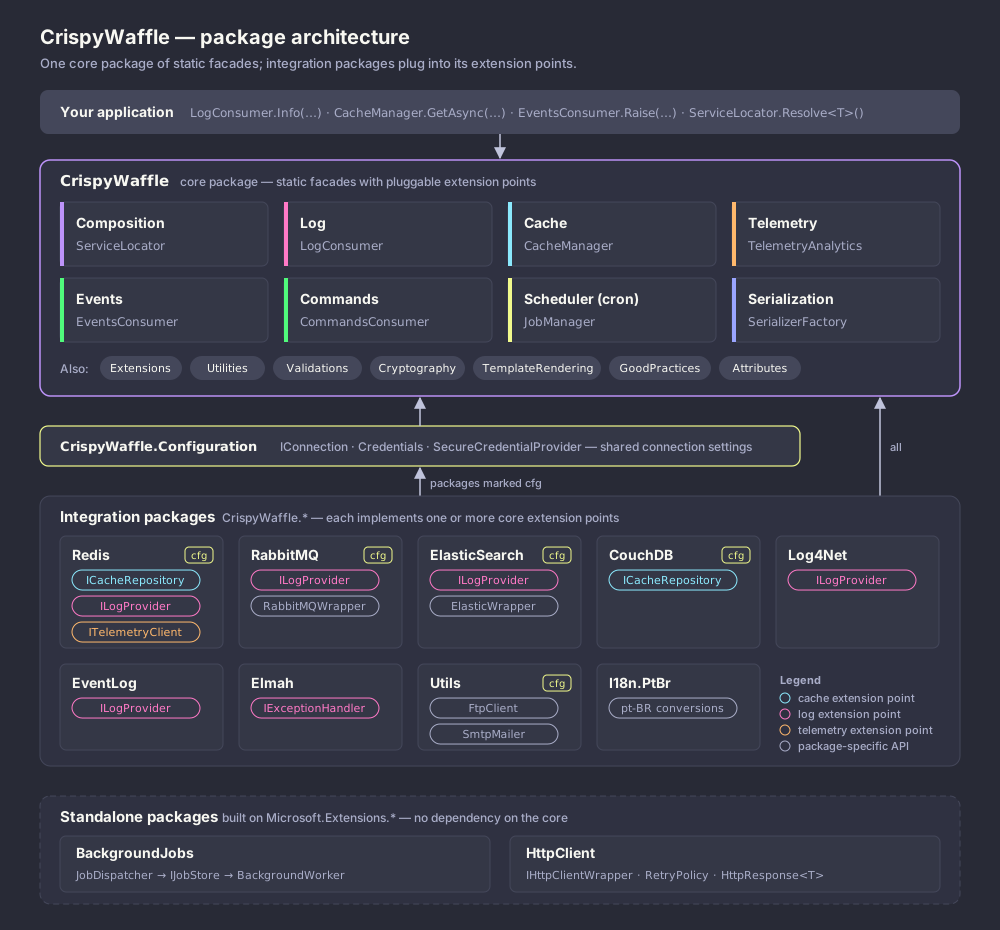
| Package architecture | The core package, its facades, and which integration packages plug into which extension point |
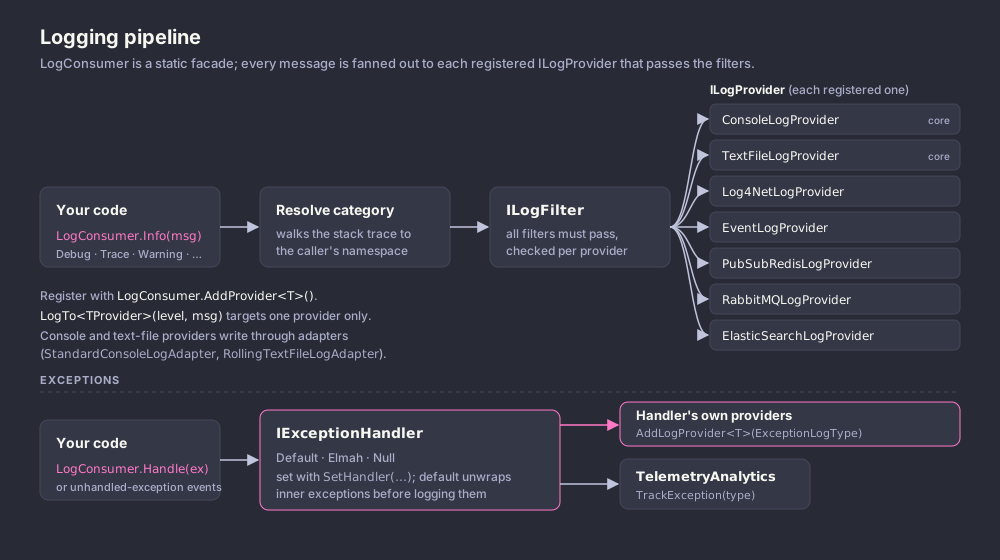
| Logging pipeline | How a log call reaches every registered provider, and how exceptions are handled |
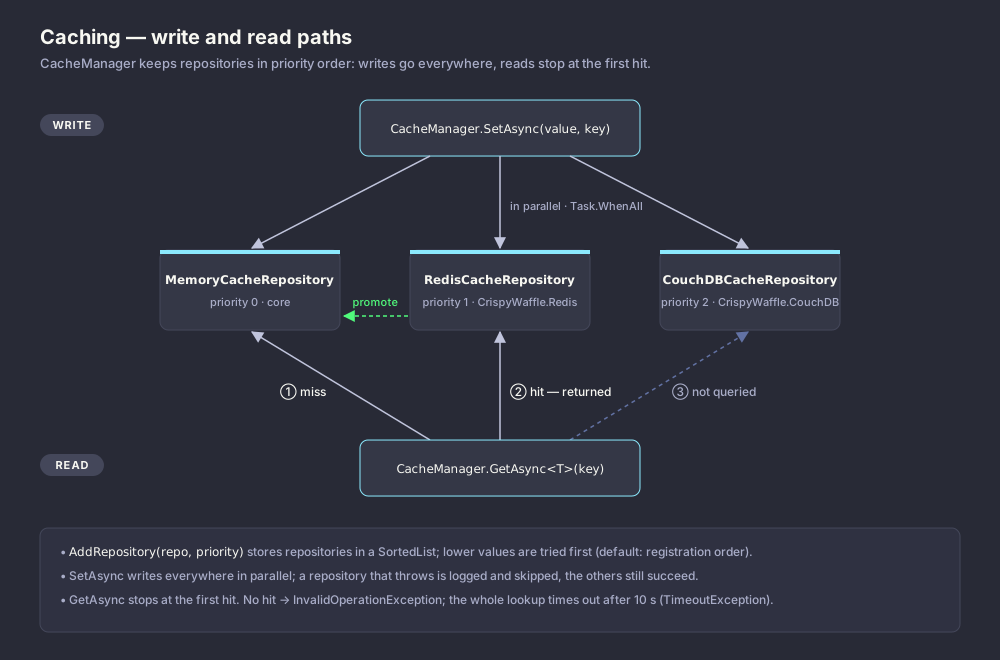
| Caching | The write path (all repositories) and the read path (priority order, promotion to memory) |
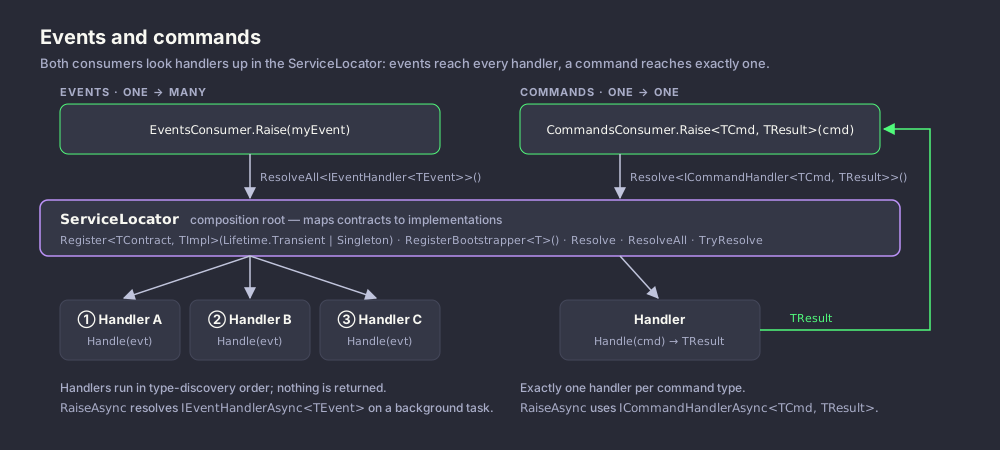
| Events and commands | One-to-many event dispatch versus one-to-one command dispatch through the service locator |
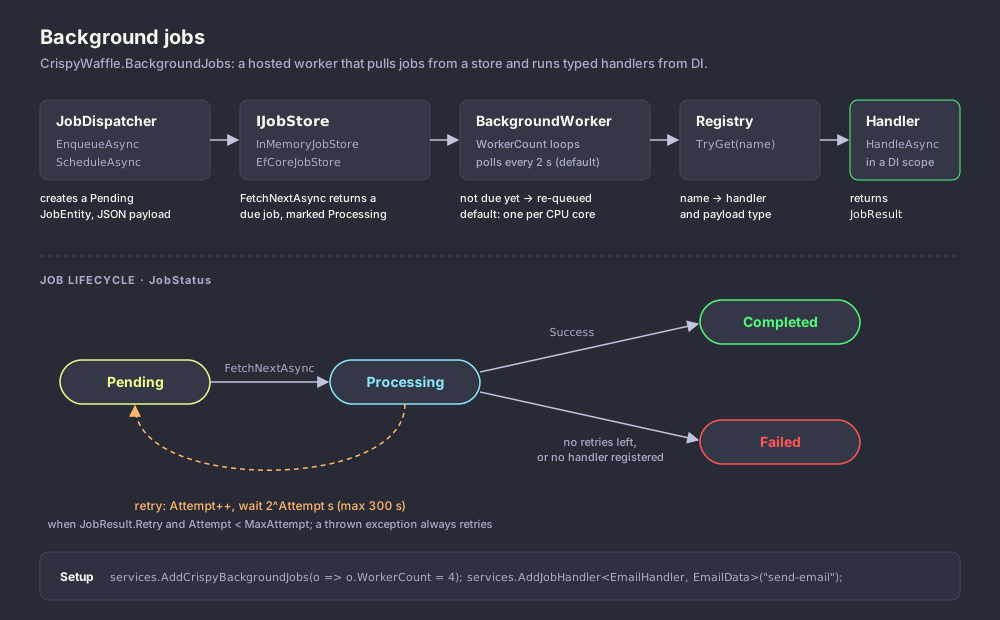
| Background jobs | The CrispyWaffle.BackgroundJobs pipeline and the job lifecycle with retries |
Package architecture
The core CrispyWaffle package exposes static facades such as LogConsumer, CacheManager and ServiceLocator. Integration packages implement the core extension points (ILogProvider, ICacheRepository, ITelemetryClient, IExceptionHandler). Packages that open connections to external services also reference CrispyWaffle.Configuration. Each module and package has its own page under Core Modules and Integration Packages. BackgroundJobs and HttpClient are standalone and build on Microsoft.Extensions.*.
Logging pipeline
LogConsumer resolves a category from the calling namespace, checks every ILogFilter for each provider, and writes to every registered ILogProvider that passes. Exceptions sent to LogConsumer.Handle go to the configured IExceptionHandler. The default handler records telemetry and writes to its own provider list (AddLogProvider<T>(ExceptionLogType)), separate from LogConsumer's providers.
See the Logging guide for usage.
Caching
CacheManager.SetAsync writes to every repository in parallel. CacheManager.GetAsync tries repositories in priority order and returns the first hit; a value found outside memory is copied into MemoryCacheRepository in the background.
See the Caching guide for usage.
Events and commands
EventsConsumer finds every IEventHandler<TEvent> implementation by scanning the loaded assemblies and calls each one in discovery order. CommandsConsumer resolves exactly one ICommandHandler<TCommand, TResult> and returns its result. Both look up handlers through the ServiceLocator.
See the Events, Commands and Service Locator guides for usage.
Background jobs
JobDispatcher saves a pending job to an IJobStore (in memory or EF Core). BackgroundWorker loops fetch due jobs, find the handler registered under the job's name, and run it in a DI scope. Failed jobs are retried with exponential backoff until MaxAttempt is reached.
See the BackgroundJobs package for usage.