CrispyWaffle.ElasticSearch
CrispyWaffle.ElasticSearch connects CrispyWaffle to Elasticsearch through the official Elastic.Clients.Elasticsearch client. It provides:
- A log provider that indexes every log message as a document and deletes old log documents once, shortly after startup.
- A small wrapper for reading and writing documents.
- Index helpers that derive index names from your types.
Use it when you want CrispyWaffle logs searchable in Elasticsearch or Kibana, or when you need simple document storage without writing client code yourself.
| Package | CrispyWaffle.ElasticSearch |
| Namespace | CrispyWaffle.ElasticSearch.Log, CrispyWaffle.ElasticSearch.Helpers, CrispyWaffle.ElasticSearch.Utils.Communications |
| Install | dotnet add package CrispyWaffle.ElasticSearch |
| Depends on | CrispyWaffle, CrispyWaffle.Configuration, Elastic.Clients.Elasticsearch |
How it works
Connecting
ElasticConnector builds an ElasticsearchClient from an IConnection:
- The scheme is
httpswhenPortis443, andhttpotherwise. - Basic authentication is added only when
Credentialsisn'tnullandCredentials.Usernameisn't blank. - The client's default index is the
defaultIndexNameconstructor argument. When you don't pass one, it'slogs-{EnvironmentHelper.ApplicationName}-{EnvironmentHelper.Version}.
Register the connector as a singleton. ElasticWrapper and ElasticSearchLogProvider take it in their constructors. The static Extensions class resolves it from ServiceLocator.
Log provider
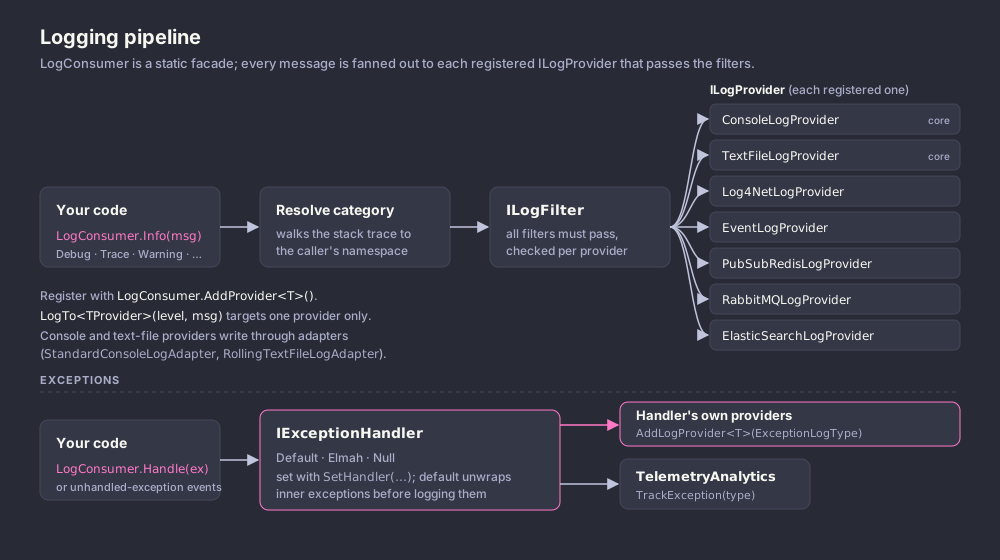
ElasticSearchLogProvider is an ILogProvider. Each logging call that passes the level check builds a LogMessage and indexes it in the connector's default index. The LogMessage carries:
- The application name, date, host name and process ID.
- The local and remote IP addresses.
- The operation, user agent, thread ID and thread name.
Indexing calls are started but not awaited. Logging never blocks, and indexing errors aren't reported back to the caller.
The provider's level starts with no flags set, so call SetLevel after adding it.
Ten seconds after it's constructed, the provider runs a single delete-by-query against the default index. The query removes LogMessage documents whose Date is older than logRetentionDays days. This cleanup runs once per provider instance, not on a schedule.
AbortGarbageCollector() and Dispose() cancel the cleanup if it hasn't run yet.
Index names
Extensions.GetIndexName<T>() decides which index a type belongs to:
- If the type has an
[IndexName]attribute, that name is used. - Otherwise, the type name in lowercase is used (with spaces replaced by
-).
ElasticWrapper's *WithResolver methods and the Extensions methods use this name. Types used with them must implement the marker interface IIndexable.
Getting started
Start Elasticsearch locally. The repository's docker-compose.yml runs elasticsearch:8.8.0 as a single node on port 9200 with security disabled.
using CrispyWaffle.Composition;
using CrispyWaffle.Configuration;
using CrispyWaffle.ElasticSearch.Log;
using CrispyWaffle.ElasticSearch.Utils.Communications;
using CrispyWaffle.Log;

var connection = new Connection { Host = "localhost", Port = 9200 };

var connector = new ElasticConnector(connection, "logs-my-app");
ServiceLocator.Register(connector);

// Index log messages and delete log documents older than 30 days.
LogConsumer
    .AddProvider(new ElasticSearchLogProvider(connector, 30))
    .SetLevel(LogLevel.Production);

LogConsumer.Info("Application started");
Reference
ElasticConnector
public sealed class ElasticConnector creates and holds the ElasticsearchClient. It has the [ConnectionName("ElasticSearch")] attribute.
| Member | Description |
|---|---|
ElasticConnector(IConnection connection) |
Uses logs-{EnvironmentHelper.ApplicationName}-{EnvironmentHelper.Version} as the default index. |
ElasticConnector(IConnection connection, string defaultIndexName) |
Builds the client for connection.Host:connection.Port with defaultIndexName as the default index. Throws ArgumentNullException when connection is null. |
Client |
The ElasticsearchClient. Use it for anything the wrapper doesn't cover. |
DefaultIndexName |
The default index name passed to the client. |
ElasticSearchLogProvider
public class ElasticSearchLogProvider : ILogProvider, IDisposable indexes log messages in Elasticsearch.
| Member | Description |
|---|---|
ElasticSearchLogProvider(ElasticConnector elastic, int logRetentionDays) |
Constructor. Uses elastic.Client and elastic.DefaultIndexName, and schedules the one-time retention cleanup to run 10 seconds later. |
SetLevel(LogLevel level) |
Sets which levels are indexed. Nothing is indexed until this is called. |
Fatal(category, message) / Error(category, message) / Warning(category, message) / Info(category, message) / Debug(category, message) |
Indexes a message at that level when the level is enabled. |
Trace(category, message) / Trace(category, message, exception) / Trace(category, exception) |
Indexes a trace message. The exception overloads also index the message and the stack trace of the exception and of each inner exception, as separate documents. |
Debug(string category, string content, string identifier) |
Indexes content at debug level with identifier as the MessageIdentifier. |
Debug<T>(string category, T content, string identifier, SerializerFormat customFormat = SerializerFormat.None) |
Serializes content with its default serializer (when customFormat is None) or with customFormat, and indexes it at debug level. T must be class, new(). |
AbortGarbageCollector() |
Cancels the pending retention cleanup. |
Dispose() |
Cancels the pending retention cleanup. The provider can still index messages afterwards. |
ElasticWrapper
public sealed class ElasticWrapper has convenience methods for single-document reads and writes. The synchronous methods block on the asynchronous client calls with .Result or .Wait(). Prefer the *Async versions.
The id parameter is typed as object but is cast to Elastic.Clients.Elasticsearch.Id, so pass an Id instance such as new Id("42"). A plain string or number throws InvalidCastException.
| Member | Description |
|---|---|
ElasticWrapper(ElasticConnector elastic) |
Constructor. Uses elastic.Client. |
IndexExists<T>() / IndexExistsAsync<T>() |
Returns whether the index for T (from GetIndexName<T>()) exists. T : class, IIndexable, new(). |
GetDocument<T>(object id) / GetDocumentAsync<T>(object id) |
Gets document id from the index the client infers for T (the default index unless you configured a mapping), and returns its source. T : class, new(). |
GetDocumentWithResolver<T>(object id) / GetDocumentWithResolverAsync<T>(object id) |
Gets document id from the index named by GetIndexName<T>(). T : class, IIndexable, new(). |
GetDocumentFrom<T>(object id, string indexName) / GetDocumentFromAsync<T>(object id, string indexName) |
Gets document id from indexName. T : class, new(). |
SetDocument<T>(T document) / SetDocumentAsync<T>(T document) |
Indexes document in the index the client infers for T. T : class, new(). |
SetDocumentWithResolver<T>(T document) / SetDocumentWithResolverAsync<T>(T document) |
Indexes document in the index named by GetIndexName<T>(). T : class, IIndexable, new(). |
SetDocumentTo<T>(T document, string indexName) / SetDocumentToAsync<T>(T document, string indexName) |
Indexes document in indexName. T : class, new(). |
Extensions
public static class Extensions (namespace CrispyWaffle.ElasticSearch.Helpers) has index-management helpers.
The extension methods use the ElasticConnector resolved from ServiceLocator the first time the class is used. Register the connector before that.
| Member | Description |
|---|---|
GetIndexName<T>() |
Returns the [IndexName] value of T, or the lowercase type name. T : class, IIndexable, new(). |
AliasAsync<T>(this T index, string alias, string indexName = null) |
Adds alias to indexName, or to GetIndexName<T>() when indexName is blank. Returns index. |
DeleteAsync<T>(this T index) |
Deletes the whole index named by GetIndexName<T>() if it exists, not just the document. Returns index. |
DeleteByQueryAsync<T>(this T index, Expression<Func<T, object>> field, string indexPattern, int daysBefore) |
Deletes documents in indexPattern whose date field is older than daysBefore days. Returns the number of deleted documents. T : class, new(). |
IIndexable
public interface IIndexable is a marker interface with no members. Implement it on document types that you use with GetIndexName<T>(), the *WithResolver methods and the Extensions methods.
IndexNameAttribute
public sealed class IndexNameAttribute : Attribute sets the index name for a class. Apply it to classes only.
| Member | Description |
|---|---|
IndexNameAttribute(string indexName) |
Constructor. |
IndexName |
The index name. |
Examples
Read and write a typed document
using CrispyWaffle.ElasticSearch.Helpers;
using CrispyWaffle.ElasticSearch.Utils.Communications;
using Elastic.Clients.Elasticsearch;

[IndexName("products")]
public class Product : IIndexable
{
    public string Id { get; set; }

    public string Name { get; set; }
}

var wrapper = new ElasticWrapper(connector);

await wrapper.SetDocumentWithResolverAsync(new Product { Id = "42", Name = "Waffle iron" });

var product = await wrapper.GetDocumentWithResolverAsync<Product>(new Id("42"));
var exists = await wrapper.IndexExistsAsync<Product>();
Remove old documents and add an alias
using CrispyWaffle.ElasticSearch.Helpers;

public class AuditEntry : IIndexable
{
    public DateTime Date { get; set; }

    public string Action { get; set; }
}

var deleted = await new AuditEntry().DeleteByQueryAsync(e => e.Date, "auditentry*", 90);

await new AuditEntry().AliasAsync("audit-current");