Commands
Commands ask the application to do something and return a result. A command is a plain class that implements ICommand. Exactly one handler, implementing ICommandHandler<TCommand, TResult> or ICommandHandlerAsync<TCommand, TResult>, processes it, and CommandsConsumer returns the handler's result to the caller.
Use commands for one-to-one requests that produce a value. To notify any number of listeners without a result, use events.
| Package | CrispyWaffle |
| Namespace | CrispyWaffle.Commands |
How it works
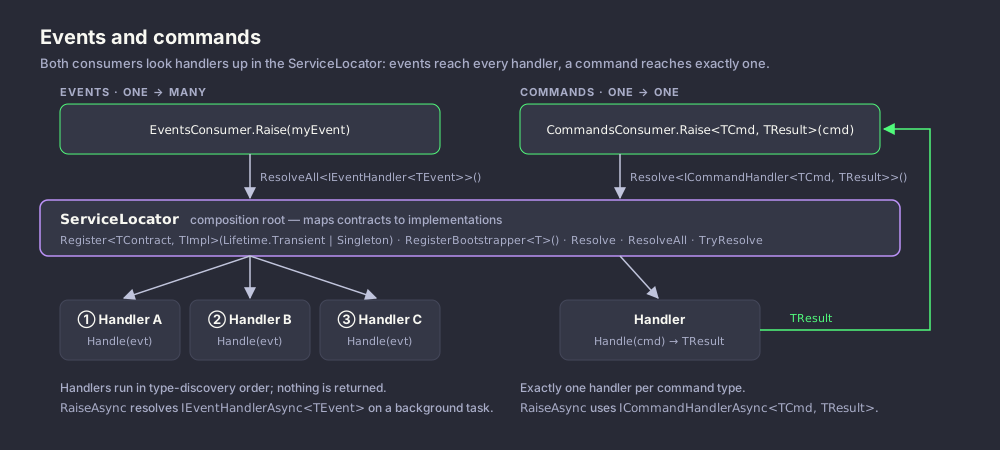
CommandsConsumer.Raise<TCommand, TResult>(command) calls ServiceLocator.Resolve<ICommandHandler<TCommand, TResult>>(), writes a trace message through LogConsumer.Trace, and returns the value of Handle(command). RaiseAsync does the same with ICommandHandlerAsync<TCommand, TResult> and returns the handler's Task<TResult> directly. Both type arguments must be given explicitly, because TResult cannot be inferred.
The handler is found by the normal service locator rules:
- If the handler interface is registered (for example
ServiceLocator.Register<ICommandHandler<MyCommand, MyResult>, MyCommandHandler>()), that registration is used. Register the handler when its constructor takes dependencies. - Otherwise the locator auto-registers the only non-abstract class that implements the interface and has a public parameterless constructor. The handler instance is then cached and reused as a singleton.
- If no handler is found,
RaisethrowsInvalidOperationException("No registrations for ..."). If more than one candidate is found, it throwsTooManyImplementationsException.
The handler runs on the calling thread, and exceptions it throws propagate to the caller.
Getting started
using System;
using CrispyWaffle.Commands;

public sealed class HelloWorldCommand : ICommand { }

public sealed class HelloWorldCommandHandler : ICommandHandler<HelloWorldCommand, string>
{
    public string Handle(HelloWorldCommand command) =>
        "Hello World, this is the result of the triggered command!";
}

public static class Program
{
    public static void Main()
    {
        var result = CommandsConsumer.Raise<HelloWorldCommand, string>(new HelloWorldCommand());
        Console.WriteLine(result);
    }
}
Reference
CommandsConsumer
public static class CommandsConsumer — sends a command to its handler and returns the result.
| Member | Description |
|---|---|
TResult Raise<TCommand, TResult>(TCommand command) |
Constraint: TCommand : ICommand. Resolves ICommandHandler<TCommand, TResult> and returns Handle(command). Throws InvalidOperationException when no handler can be resolved and TooManyImplementationsException when several unregistered candidates exist. |
Task<TResult> RaiseAsync<TCommand, TResult>(TCommand command) |
Constraint: TCommand : ICommand. Resolves ICommandHandlerAsync<TCommand, TResult> and returns HandleAsync(command). Resolution errors are thrown synchronously, before a task is returned. |
ICommand
public interface ICommand — marker interface for command classes.
It has no members. Put the command's input in properties of the class.
ICommandHandler<TCommand, TResult>
public interface ICommandHandler<in TCommand, out TResult> where TCommand : ICommand — handles a command synchronously.
| Member | Description |
|---|---|
TResult Handle(TCommand command) |
Processes the command and returns its result. |
ICommandHandlerAsync<TCommand, TResult>
public interface ICommandHandlerAsync<in TCommand, TResult> where TCommand : ICommand — handles a command asynchronously.
| Member | Description |
|---|---|
Task<TResult> HandleAsync(TCommand command) |
Processes the command and returns a task with its result. |
Examples
Returning a class as a result
The command carries input data and the handler returns a result object.
using System;
using CrispyWaffle.Commands;
using CrispyWaffle.Log;

var result = CommandsConsumer.Raise<SomeCommand, SomeCommandResult>(new SomeCommand(10));
Console.WriteLine($"New quantity: {result.Quantity}");

public sealed class SomeCommand(int quantity) : ICommand
{
    public Guid Id { get; } = Guid.NewGuid();

    public DateTime Date { get; } = DateTime.Now;

    public int Quantity { get; } = quantity;
}

public sealed class SomeCommandResult(int newQuantity)
{
    public int Quantity { get; } = newQuantity;
}

public sealed class SomeCommandHandler : ICommandHandler<SomeCommand, SomeCommandResult>
{
    public SomeCommandResult Handle(SomeCommand command)
    {
        LogConsumer.Warning(
            "Command 'SomeCommand' handled by 'SomeCommandHandler'. Command Id: {0}",
            command.Id
        );

        return new SomeCommandResult(command.Quantity * 2);
    }
}
Synchronous and asynchronous handling in one class
This pattern comes from the test suite. The same class implements both handler interfaces.
using System;
using System.Threading.Tasks;
using CrispyWaffle.Commands;

var command = new TestDoneCommand(Guid.NewGuid(), "Sample test");

var result = CommandsConsumer.Raise<TestDoneCommand, TestDoneResultCommand>(command);
var resultAsync = await CommandsConsumer.RaiseAsync<TestDoneCommand, TestDoneResultCommand>(
    command
);

public sealed class TestDoneCommand(Guid identifier, string text) : ICommand
{
    public Guid Identifier { get; } = identifier;

    public string Text { get; } = text;

    public DateTime CreatedDateTime { get; } = DateTime.UtcNow;
}

public sealed class TestDoneResultCommand(string text)
{
    public string Text { get; } = text;
}

public sealed class TestDoneCommandHandler
    : ICommandHandler<TestDoneCommand, TestDoneResultCommand>,
        ICommandHandlerAsync<TestDoneCommand, TestDoneResultCommand>
{
    public TestDoneResultCommand Handle(TestDoneCommand command) =>
        new($"Sample done action handled: {command.Identifier} - {command.Text}");

    public Task<TestDoneResultCommand> HandleAsync(TestDoneCommand command) =>
        Task.Run(() =>
            new TestDoneResultCommand(
                $"Sample done action handled: {command.Identifier} - {command.Text}"
            )
        );
}
A handler with dependencies
Handlers without a parameterless constructor are not auto-registered. Register them explicitly; their dependencies are injected by the service locator.
using CrispyWaffle.Commands;
using CrispyWaffle.Composition;

ServiceLocator.Register<IPriceCatalog, FixedPriceCatalog>(Lifetime.Singleton);
ServiceLocator.Register<ICommandHandler<GetPriceCommand, decimal>, GetPriceCommandHandler>();

var price = CommandsConsumer.Raise<GetPriceCommand, decimal>(new GetPriceCommand("SKU-1"));

public interface IPriceCatalog
{
    decimal PriceOf(string sku);
}

public sealed class FixedPriceCatalog : IPriceCatalog
{
    public decimal PriceOf(string sku) => 9.99m;
}

public sealed class GetPriceCommand(string sku) : ICommand
{
    public string Sku { get; } = sku;
}

public sealed class GetPriceCommandHandler : ICommandHandler<GetPriceCommand, decimal>
{
    private readonly IPriceCatalog _catalog;

    public GetPriceCommandHandler(IPriceCatalog catalog) => _catalog = catalog;

    public decimal Handle(GetPriceCommand command) => _catalog.PriceOf(command.Sku);
}