CrispyWaffle.BackgroundJobs
CrispyWaffle.BackgroundJobs runs fire-and-forget and delayed jobs inside an ASP.NET Core application. You register typed handlers under a name, enqueue a job with that name and a payload, and a hosted worker picks it up, runs the handler in its own DI scope, and retries it with exponential backoff when it fails. Jobs are kept in an in-memory store by default, or in a database through Entity Framework Core.
The package is standalone: it does not reference the core CrispyWaffle package. It is built on Microsoft.Extensions.Hosting (BackgroundService) and Microsoft.Extensions.DependencyInjection. It is a different thing from the core package's cron scheduler: that one runs in-process actions on cron expressions through JobManager, while this package queues persisted, retryable jobs that carry a payload. The CronJobService base class in this package does not parse cron expressions (see Recurring work).
| Package | CrispyWaffle.BackgroundJobs |
| Namespace | CrispyWaffle.BackgroundJobs.Abstractions, CrispyWaffle.BackgroundJobs.Core, CrispyWaffle.BackgroundJobs.Extensions, CrispyWaffle.BackgroundJobs.Persistence, CrispyWaffle.BackgroundJobs.Scheduling, CrispyWaffle.BackgroundJobs.Monitoring, CrispyWaffle.BackgroundJobs.Exceptions |
| Install | Not yet published to NuGet (it is not in the release workflow's package list). Reference the project: dotnet add reference Src/CrispyWaffle.BackgroundJobs/CrispyWaffle.BackgroundJobs.csproj |
| Target framework | net10.0 only |
| Depends on | No CrispyWaffle packages. Microsoft.Extensions.Hosting.Abstractions, Microsoft.AspNetCore.Hosting.Abstractions (for IStartupFilter and the middleware), Microsoft.EntityFrameworkCore and Microsoft.EntityFrameworkCore.Relational |
How it works
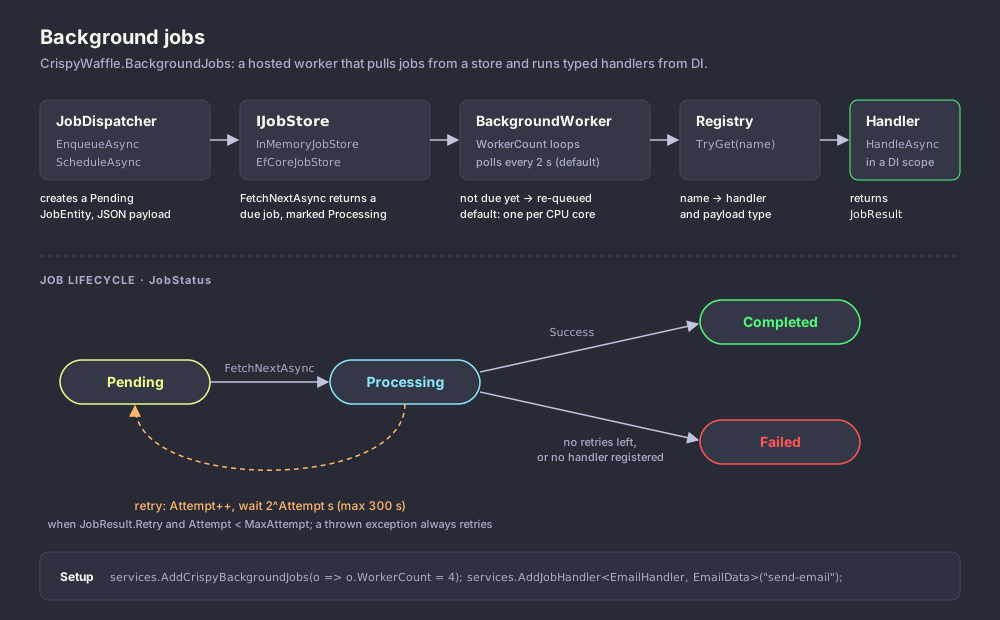
Registration
AddCrispyBackgroundJobs registers, all as singletons unless noted:
| Service | Implementation |
|---|---|
JobOptions |
The instance built from your configureOptions callback |
IJobHandlerRegistry |
JobHandlerRegistry |
JobDispatcher |
JobDispatcher |
JobMetrics |
JobMetrics |
IJobScheduler |
DelayedJobScheduler |
IJobStore |
InMemoryJobStore (default), or EfCoreJobStore as scoped when useEfCoreStore: true |
BackgroundJobQueue |
Only in the default (in-memory) mode |
| Hosted service | BackgroundWorker |
IJobStore and BackgroundJobQueue are added with TryAdd, so a store you register before the call wins.
AddJobHandler<THandler, TData>(name) registers THandler as scoped and adds an IStartupFilter that calls IJobHandlerRegistry.Register<THandler, TData>(name) when the ASP.NET Core request pipeline is built. This means AddJobHandler only populates the registry in an ASP.NET Core host. In a generic host (worker service) the filter never runs; register the handler type in DI yourself and call Register on the registry after building the host (see Use a generic host).
Enqueueing
JobDispatcher.EnqueueAsync (or IJobScheduler.EnqueueAsync) creates a JobEntity with Status = Pending, the handler name, the priority, MaxAttempt, and the payload serialized with System.Text.Json default options, then saves it with IJobStore.SaveAsync. ScheduleAsync does the same with ScheduledAt = UtcNow + delay; the job stays in the store until it is due.
Only when no IJobStore is registered does the dispatcher fall back to the BackgroundJobQueue: EnqueueAsync pushes the job onto the queue, and ScheduleAsync waits for the delay in a background Task and then pushes it. With AddCrispyBackgroundJobs a store is always registered, so this path is not used.
Worker loop
BackgroundWorker starts JobOptions.WorkerCount loops (default: one per processor). Each loop:
- Calls
IJobStore.FetchNextAsync, which returns the oldest duePendingjob with the highest priority (HighbeforeNormalbeforeLow, then byCreatedAt) and marks itProcessing. If nothing is due, the loop sleeps forJobOptions.PollingInterval(default 2 seconds). - If the job's
ScheduledAtis still in the future, puts it back (MarkRetryAsyncwith the same time) and moves on. - Creates a DI scope, looks up the handler type and payload type in
IJobHandlerRegistry, deserializes the payload into the payload type, resolves the handler from the scope, and calls itsHandleAsync. - Records the outcome in the store (see below).
An unexpected error in the loop itself is logged and the loop waits 1 second before continuing.
The handler is invoked by reflection: the worker looks up a public method named HandleAsync on the concrete handler type. Implement IBackgroundJobHandler<TData>.HandleAsync as a normal public method, not as an explicit interface implementation, and do not add other HandleAsync overloads; otherwise the call throws and the job is retried as described below.
Lifecycle and retries
| Outcome | What happens |
|---|---|
Handler returns JobResult.Ok() |
MarkCompletedAsync: status Completed. |
Handler returns JobResult.Fail(message, retry: true) and Attempt + 1 < MaxAttempt |
Attempt is incremented and MarkRetryAsync sets status Pending with ScheduledAt = UtcNow + backoff. |
Handler returns Fail with retry: false, or attempts are used up |
MarkFailedAsync: status Failed, LastError = message (or "Job failed" when the message is null). |
| No handler registered under the job's name | MarkFailedAsync with "No handler registered for '<name>'". Not retried. |
| Handler type cannot be resolved from DI | MarkFailedAsync with "Handler type <type> not resolved from DI". Not retried. |
| Handler throws, or the payload cannot be deserialized | Logged, Attempt incremented, rescheduled with backoff. MaxAttempt is not checked on this path, so a job that always throws is retried indefinitely (every 300 seconds once the cap is reached). |
The backoff is min(2^min(Attempt, 10), 300) seconds, where Attempt is the already incremented count: 2, 4, 8, 16, 32, 64, 128, 256, then 300 seconds. The cap is hard-coded; JobOptions.MaxBackoffSeconds is not read. JobEntity.RetryDelaySeconds is also not read.
MaxAttempt counts total executions. With the default of 3, a handler that keeps returning Fail(..., retry: true) runs three times and is then marked Failed.
On shutdown, a job interrupted by the stopping token is normally caught by the "handler throws" path and rescheduled with backoff. The JobStatus.Dead value is never assigned by the library.
Job stores
In-memory (default). InMemoryJobStore keeps jobs in a ConcurrentDictionary. Jobs are lost when the process stops, and completed and failed jobs are never removed. FetchNextAsync selects and marks a job in two separate steps without a lock, so with more than one worker the same job can occasionally be picked by two loops. Set WorkerCount = 1 if handlers must not run twice.
EF Core. Pass useEfCoreStore: true and register JobDbContext yourself with your database provider, for example services.AddDbContext<JobDbContext>(o => o.UseSqlServer(connectionString)). You must also create the Jobs table, for example with db.Database.EnsureCreated() or with migrations generated against JobDbContext (migrations need a MigrationsAssembly in your project, since the context lives in this package).
The EF Core mode has wiring problems you need to work around:
JobDispatchertakes aBackgroundJobQueueconstructor parameter, but the queue is only registered in in-memory mode. Withoutservices.AddSingleton<BackgroundJobQueue>(), resolvingJobDispatcherorIJobSchedulerfails.EfCoreJobStoreis scoped, but the singletonBackgroundWorkerandJobDispatcherresolve it from the root provider. With scope validation enabled (the default in theDevelopmentenvironment) the host fails to start with a "Cannot consume scoped service" error. With validation disabled, a singleJobDbContextinstance is shared by every worker loop and every caller of the dispatcher.DbContextis not thread-safe, so keepWorkerCount = 1and avoid enqueueing while the worker is running, or register your ownIJobStorethat creates a context per call.- No concurrency token is configured on
JobEntity, soFetchNextAsyncdoes not prevent two processes from claiming the same job.
Treat the EF Core store as experimental until these are fixed.
Monitoring
JobMetrics is a singleton dictionary of named counters. The library registers it but does not increment any counter itself, so you record the values you care about, for example from your handlers. MonitoringMiddleware serves JobMetrics.Snapshot() as a JSON object ({"counter": value}) for any request whose path starts with the segment /jobs/metrics, and passes every other request on. There is no UseXxx extension; add it with app.UseMiddleware<MonitoringMiddleware>(). The endpoint has no authentication of its own.
Recurring work
CronJobService is an abstract BackgroundService that calls ExecuteOnce in a loop with a fixed one-minute delay after each run. Despite the file name (CronJobScheduler.cs), it does not accept or parse a cron expression, and it is not registered by AddCrispyBackgroundJobs. Register a subclass with AddHostedService. For real cron expressions, use the core scheduler, or enqueue jobs from your subclass.
Getting started
using CrispyWaffle.BackgroundJobs.Abstractions;
using CrispyWaffle.BackgroundJobs.Core;
using CrispyWaffle.BackgroundJobs.Extensions;

var builder = WebApplication.CreateBuilder(args);

builder.Services.AddCrispyBackgroundJobs(o => o.WorkerCount = 2);
builder.Services.AddJobHandler<SendEmailHandler, SendEmailData>("send-email");

var app = builder.Build();

app.MapPost(
    "/signup",
    async (string email, IJobScheduler jobs) =>
    {
        await jobs.EnqueueAsync("send-email", new SendEmailData(email, "Welcome!"));
        return Results.Accepted();
    }
);

app.Run();

public sealed record SendEmailData(string To, string Subject);

public sealed class SendEmailHandler(ILogger<SendEmailHandler> logger)
    : IBackgroundJobHandler<SendEmailData>
{
    public async Task<JobResult> HandleAsync(SendEmailData data, CancellationToken cancellationToken)
    {
        try
        {
            logger.LogInformation("Sending '{Subject}' to {To}", data.Subject, data.To);
            await Task.Delay(100, cancellationToken); // send the email here
            return JobResult.Ok();
        }
        catch (HttpRequestException ex)
        {
            return JobResult.Fail(ex.Message, retry: true);
        }
    }
}
Reference
ServiceCollectionExtensions
public static class ServiceCollectionExtensions — registration entry points (namespace CrispyWaffle.BackgroundJobs.Extensions).
| Member | Description |
|---|---|
AddCrispyBackgroundJobs(this IServiceCollection services, Action<JobOptions>? configureOptions = null, bool useEfCoreStore = false) |
Registers the services listed in Registration and the BackgroundWorker hosted service. With useEfCoreStore: true, registers EfCoreJobStore as scoped IJobStore; you must register JobDbContext (and, see Job stores, BackgroundJobQueue). Returns services. |
AddJobHandler<THandler, TData>(this IServiceCollection services, string handlerName) |
Constraint: THandler : class, IBackgroundJobHandler<TData>. Registers THandler as scoped and an IStartupFilter that adds handlerName to the registry when the ASP.NET Core pipeline is built. Has no effect on the registry in a non-web host. Returns services. |
IJobScheduler
public interface IJobScheduler — the injectable API for adding jobs (namespace CrispyWaffle.BackgroundJobs.Abstractions).
| Member | Description |
|---|---|
EnqueueAsync(string handlerName, object payload, int maxAttempts = 3, JobPriority priority = JobPriority.Normal) |
Adds a job that is due immediately. Returns Task (the job id is not exposed; use JobDispatcher to get it). |
ScheduleAsync(string handlerName, object payload, TimeSpan delay, int maxAttempts = 3, JobPriority priority = JobPriority.Normal) |
Adds a job that becomes due after delay. Returns Task. |
Because maxAttempts defaults to 3 here and is always passed on, JobOptions.DefaultMaxAttempt has no effect for jobs added through IJobScheduler.
DelayedJobScheduler
public class DelayedJobScheduler : IJobScheduler — default IJobScheduler; forwards both methods to JobDispatcher (namespace CrispyWaffle.BackgroundJobs.Scheduling).
| Member | Description |
|---|---|
DelayedJobScheduler(IServiceProvider provider) |
Constructor. JobDispatcher is resolved from provider on every call. |
EnqueueAsync(...) / ScheduleAsync(...) |
See IJobScheduler. |
JobDispatcher
public class JobDispatcher — creates JobEntity records and hands them to the store or the queue (namespace CrispyWaffle.BackgroundJobs.Core).
| Member | Description |
|---|---|
JobDispatcher(IServiceProvider provider, BackgroundJobQueue? queue, IJobStore? store, JobOptions options) |
Constructor. Despite the nullable annotations, the DI container requires both BackgroundJobQueue and IJobStore to be registered. |
EnqueueAsync(string handlerName, object payload, int? maxAttempts = null, JobPriority priority = JobPriority.Normal) |
Creates a pending job (MaxAttempt = maxAttempts ?? options.DefaultMaxAttempt) and saves it to the store, or enqueues it when there is no store. Returns Task<Guid>, the job id. |
ScheduleAsync(string handlerName, object payload, TimeSpan delay, int? maxAttempts = null, JobPriority priority = JobPriority.Normal) |
Same, with ScheduledAt = UtcNow + delay. Without a store, waits delay in a background task before enqueueing (lost if the process stops). Returns Task. |
IBackgroundJobHandler<TData>
public interface IBackgroundJobHandler<TData> — implement this to handle one kind of job (namespace CrispyWaffle.BackgroundJobs.Abstractions). Handlers are resolved from a new DI scope per job, so they can depend on scoped services.
| Member | Description |
|---|---|
HandleAsync(TData data, CancellationToken cancellationToken) |
Runs the job. data is the payload deserialized with System.Text.Json default options (null/default when the payload is empty). The token is the host's stopping token. Return JobResult.Ok() or JobResult.Fail(...). Must be a public method on the handler class (see Worker loop). |
IBackgroundJob
public interface IBackgroundJob — a payload-less job abstraction (namespace CrispyWaffle.BackgroundJobs.Abstractions). Nothing in the package executes it; the worker only runs IBackgroundJobHandler<TData> handlers.
| Member | Description |
|---|---|
ExecuteAsync(CancellationToken cancellationToken) |
Returns Task<JobResult>. |
JobResult
public sealed record JobResult(bool Success, bool Retry = false, string? ErrorMessage = null) — the outcome returned by a handler (namespace CrispyWaffle.BackgroundJobs.Core).
| Member | Description |
|---|---|
Success |
true when the job succeeded. |
Retry |
When Success is false, whether the worker should retry (subject to MaxAttempt). |
ErrorMessage |
Stored in JobEntity.LastError when the job ends as Failed. |
Ok() |
Static. Returns a successful result. |
Fail(string message, bool retry = false) |
Static. Returns a failed result. Note that retry defaults to false, so a plain Fail("...") is not retried. |
IJobHandlerRegistry
public interface IJobHandlerRegistry — maps handler names to handler and payload types (namespace CrispyWaffle.BackgroundJobs.Core).
| Member | Description |
|---|---|
Register<THandler, TData>(string handlerName) |
Constraint: THandler : class, IBackgroundJobHandler<TData>. Adds or replaces the mapping for handlerName. |
TryGet(string handlerName, out Type? handlerType, out Type? dataType) |
Returns true and the two types when handlerName is registered. |
JobHandlerRegistry
public class JobHandlerRegistry : IJobHandlerRegistry — thread-safe default registry backed by a ConcurrentDictionary.
| Member | Description |
|---|---|
Register<THandler, TData>(string handlerName) |
Throws ArgumentException when handlerName is null, empty or whitespace. Names are case-sensitive. |
TryGet(string handlerName, out Type? handlerType, out Type? dataType) |
Returns false for a null or unknown name. |
IJobStore
public interface IJobStore — persistence for jobs (namespace CrispyWaffle.BackgroundJobs.Abstractions). Implement it to use another storage; register your implementation before calling AddCrispyBackgroundJobs.
| Member | Description |
|---|---|
SaveAsync(JobEntity job, CancellationToken cancellationToken = default) |
Stores a new job. |
FetchNextAsync(CancellationToken cancellationToken = default) |
Returns the next due Pending job (ScheduledAt null or not after now) and marks it Processing, or null. Implementations should claim the job atomically. |
MarkCompletedAsync(Guid jobId, CancellationToken cancellationToken = default) |
Sets status Completed. |
MarkFailedAsync(Guid jobId, string error, CancellationToken cancellationToken = default) |
Sets status Failed and LastError. |
MarkRetryAsync(Guid jobId, DateTimeOffset? nextAttemptAt, int attemptCount, CancellationToken cancellationToken = default) |
Sets status Pending, ScheduledAt = nextAttemptAt and Attempt = attemptCount. |
InMemoryJobStore
public class InMemoryJobStore : IJobStore — default store, process-local (namespace CrispyWaffle.BackgroundJobs.Persistence). Implements every IJobStore member; all methods complete synchronously and ignore the token. Unknown ids are ignored. See Job stores for its limits.
EfCoreJobStore
public class EfCoreJobStore : IJobStore — store backed by JobDbContext (namespace CrispyWaffle.BackgroundJobs.Persistence).
| Member | Description |
|---|---|
EfCoreJobStore(JobDbContext db) |
Constructor. |
SaveAsync(...) |
Sets UpdatedAt, adds the job and calls SaveChangesAsync. |
FetchNextAsync(...) |
Queries the first due pending job id ordered by priority then CreatedAt, loads it, sets Processing and saves. Returns null if nothing is due or if SaveChangesAsync throws DbUpdateConcurrencyException. |
MarkCompletedAsync(...) / MarkFailedAsync(...) / MarkRetryAsync(...) |
Load the job, update it as described in IJobStore, and save. Unknown ids are ignored. |
JobDbContext
public class JobDbContext : DbContext — EF Core context for the EfCoreJobStore (namespace CrispyWaffle.BackgroundJobs.Persistence).
| Member | Description |
|---|---|
JobDbContext(DbContextOptions<JobDbContext> options) |
Constructor, used by AddDbContext<JobDbContext>. |
Jobs |
DbSet<JobEntity>. |
OnModelCreating(ModelBuilder modelBuilder) |
Protected. Key Id; HandlerName required, max length 256; Payload optional; Priority and Status stored as int; CreatedAt and UpdatedAt required; database defaults MaxAttempt = 3 and Attempt = 0. |
BackgroundWorker
public class BackgroundWorker : BackgroundService — the hosted service that runs jobs (namespace CrispyWaffle.BackgroundJobs.Core). Registered by AddCrispyBackgroundJobs; you do not use it directly. See Worker loop and Lifecycle and retries.
| Member | Description |
|---|---|
BackgroundWorker(IServiceProvider provider, JobOptions options, ILogger<BackgroundWorker> logger) |
Constructor. Resolves BackgroundJobQueue and IJobStore (both optional) and IJobHandlerRegistry (required) from provider. Uses the store when one is registered, otherwise the queue. |
ExecuteAsync(CancellationToken stoppingToken) |
Protected override. Starts WorkerCount loops and completes when all of them stop. |
BackgroundJobQueue
public class BackgroundJobQueue — in-memory priority queue used only when no IJobStore is registered (namespace CrispyWaffle.BackgroundJobs.Core).
| Member | Description |
|---|---|
Enqueue(JobEntity job) |
Adds the job with its Priority (lower value first) and signals a waiting consumer. |
DequeueAsync(CancellationToken cancellationToken) |
Waits for a signal and returns the highest-priority job. Returns null when cancelled. |
When the worker uses this queue, a job that is not yet due is dequeued and enqueued again in a tight loop until it is due.
JobOptions
public class JobOptions — worker settings, configured through AddCrispyBackgroundJobs (namespace CrispyWaffle.BackgroundJobs.Core). Registered as a plain singleton, not through IOptions<T>.
| Member | Description |
|---|---|
WorkerCount |
int. Number of concurrent worker loops. Default Environment.ProcessorCount. |
DefaultMaxAttempt |
int. MaxAttempt for jobs added through JobDispatcher without maxAttempts. Default 3. |
PollingInterval |
TimeSpan. Sleep between store polls when no job is due. Default 2 seconds. |
MaxBackoffSeconds |
int. Default 300. Not used; the worker's 300-second cap is hard-coded. |
JobEntity
public class JobEntity — a stored job (namespace CrispyWaffle.BackgroundJobs.Abstractions).
| Member | Description |
|---|---|
Id |
Guid. Default Guid.NewGuid(). |
HandlerName |
string. Name registered in IJobHandlerRegistry. Default empty. |
Payload |
string. JSON payload. Default empty. |
Priority |
JobPriority. Default Normal. |
Status |
JobStatus. Default Pending. |
ScheduledAt |
DateTimeOffset?. When the job becomes due; null means immediately. |
Attempt |
int. Number of failed executions so far. Default 0. |
MaxAttempt |
int. Maximum executions for JobResult.Fail(..., retry: true) outcomes. Default 3. |
LastError |
string?. Error recorded when the job is marked Failed. |
CreatedAt |
DateTimeOffset. Default UtcNow at construction. |
UpdatedAt |
DateTimeOffset. Updated by the stores on every change. |
RetryDelaySeconds |
int. Default 0. Not used by the worker. |
JobPriority
public enum JobPriority — lower values run first.
| Value | Description |
|---|---|
High (0) |
Picked before Normal and Low. |
Normal (1) |
Default. |
Low (2) |
Picked last. |
JobStatus
public enum JobStatus — job lifecycle state.
| Value | Description |
|---|---|
Pending (0) |
Waiting to run, or waiting for a retry. |
Processing (1) |
Claimed by a worker. |
Completed (2) |
Handler returned success. |
Failed (3) |
Handler failed with no retries left, did not ask for a retry, or could not be found. |
Dead (4) |
Not used by the library. |
JobMetrics
public class JobMetrics — thread-safe named counters, registered as a singleton (namespace CrispyWaffle.BackgroundJobs.Monitoring). Nothing in the package increments them.
| Member | Description |
|---|---|
Increment(string key) |
Adds 1 to key, creating it at 1. |
Get(string key) |
Returns the value of key, or 0. |
Snapshot() |
Returns a copy of all counters as IDictionary<string, long>. |
MonitoringMiddleware
public class MonitoringMiddleware — ASP.NET Core middleware that exposes JobMetrics (namespace CrispyWaffle.BackgroundJobs.Monitoring).
| Member | Description |
|---|---|
MonitoringMiddleware(RequestDelegate next, JobMetrics metrics) |
Constructor, called by UseMiddleware<MonitoringMiddleware>(). |
InvokeAsync(HttpContext context) |
For paths starting with /jobs/metrics, writes the snapshot as application/json and ends the request. Otherwise calls next. |
CronJobService
public abstract class CronJobService : BackgroundService — base class for work that repeats every minute (namespace CrispyWaffle.BackgroundJobs.Scheduling). See Recurring work.
| Member | Description |
|---|---|
CronJobService(ILogger logger) |
Protected constructor. |
ExecuteOnce(CancellationToken stoppingToken) |
Protected abstract. Your work. Exceptions are logged and the loop continues. |
ExecuteAsync(CancellationToken stoppingToken) |
Protected override. Calls ExecuteOnce, then waits one minute, until the host stops. |
JobFailedException
public class JobFailedException : Exception — namespace CrispyWaffle.BackgroundJobs.Exceptions. Has one constructor, JobFailedException(string message). The package never throws it; if a handler throws it, it is treated like any other exception (logged and retried).
Examples
Schedule a delayed, high-priority job
JobDispatcher returns the job id; IJobScheduler does not.
using CrispyWaffle.BackgroundJobs.Abstractions;
using CrispyWaffle.BackgroundJobs.Core;

public sealed class ReminderService(JobDispatcher dispatcher)
{
    public Task<Guid> RemindNowAsync(string email) =>
        dispatcher.EnqueueAsync("send-email", new SendEmailData(email, "Reminder"));

    public Task RemindLaterAsync(string email) =>
        dispatcher.ScheduleAsync(
            "send-email",
            new SendEmailData(email, "Your trial ends tomorrow"),
            TimeSpan.FromHours(1),
            maxAttempts: 5,
            priority: JobPriority.High
        );
}
Expose metrics
Increment counters from your handlers and map the middleware.
using CrispyWaffle.BackgroundJobs.Abstractions;
using CrispyWaffle.BackgroundJobs.Core;
using CrispyWaffle.BackgroundJobs.Extensions;
using CrispyWaffle.BackgroundJobs.Monitoring;

var builder = WebApplication.CreateBuilder(args);
builder.Services.AddCrispyBackgroundJobs();
builder.Services.AddJobHandler<ResizeImageHandler, ResizeImageData>("resize-image");

var app = builder.Build();
app.UseMiddleware<MonitoringMiddleware>(); // GET /jobs/metrics -> {"resize-image.ok":12}
app.Run();

public sealed record ResizeImageData(string Path, int Width);

public sealed class ResizeImageHandler(JobMetrics metrics) : IBackgroundJobHandler<ResizeImageData>
{
    public Task<JobResult> HandleAsync(ResizeImageData data, CancellationToken cancellationToken)
    {
        // resize data.Path to data.Width here
        metrics.Increment("resize-image.ok");
        return Task.FromResult(JobResult.Ok());
    }
}
Use the EF Core store
Register the context, the queue that JobDispatcher needs, and create the table at startup. Keep one worker because the store's DbContext is shared (see Job stores), and disable scope validation, which otherwise rejects the scoped store inside singletons.
using CrispyWaffle.BackgroundJobs.Core;
using CrispyWaffle.BackgroundJobs.Extensions;
using CrispyWaffle.BackgroundJobs.Persistence;
using Microsoft.EntityFrameworkCore;

var builder = WebApplication.CreateBuilder(args);
builder.Host.UseDefaultServiceProvider(o =>
{
    o.ValidateScopes = false;
    o.ValidateOnBuild = false;
});

builder.Services.AddDbContext<JobDbContext>(o =>
    o.UseSqlServer(builder.Configuration.GetConnectionString("Jobs"))
);
builder.Services.AddSingleton<BackgroundJobQueue>();
builder.Services.AddCrispyBackgroundJobs(o => o.WorkerCount = 1, useEfCoreStore: true);
builder.Services.AddJobHandler<SendEmailHandler, SendEmailData>("send-email");

var app = builder.Build();
using (var scope = app.Services.CreateScope())
{
    scope.ServiceProvider.GetRequiredService<JobDbContext>().Database.EnsureCreated();
}
app.Run();
UseSqlServer comes from the Microsoft.EntityFrameworkCore.SqlServer package; use the provider for your database.
Use a generic host
AddJobHandler relies on an ASP.NET Core startup filter. In a worker service, register the handler in DI and in the registry yourself before the host starts.
using CrispyWaffle.BackgroundJobs.Core;
using CrispyWaffle.BackgroundJobs.Extensions;

var builder = Host.CreateApplicationBuilder(args);
builder.Services.AddCrispyBackgroundJobs();
builder.Services.AddScoped<SendEmailHandler>();

var host = builder.Build();
host.Services.GetRequiredService<IJobHandlerRegistry>()
    .Register<SendEmailHandler, SendEmailData>("send-email");

host.Run();
Run work every minute
using CrispyWaffle.BackgroundJobs.Abstractions;
using CrispyWaffle.BackgroundJobs.Scheduling;

public sealed class CleanupService(ILogger<CleanupService> logger, IJobScheduler jobs)
    : CronJobService(logger)
{
    protected override Task ExecuteOnce(CancellationToken stoppingToken) =>
        jobs.EnqueueAsync("cleanup", new { OlderThanDays = 30 });
}

// builder.Services.AddHostedService<CleanupService>();
The anonymous payload is serialized as {"OlderThanDays":30}, so the cleanup handler's payload type needs a matching OlderThanDays property.
See also
- Diagrams
- Scheduler for cron-based scheduling in the core package
- HTTP client, the other standalone
Microsoft.Extensionsbased package