CrispyWaffle.Log4Net
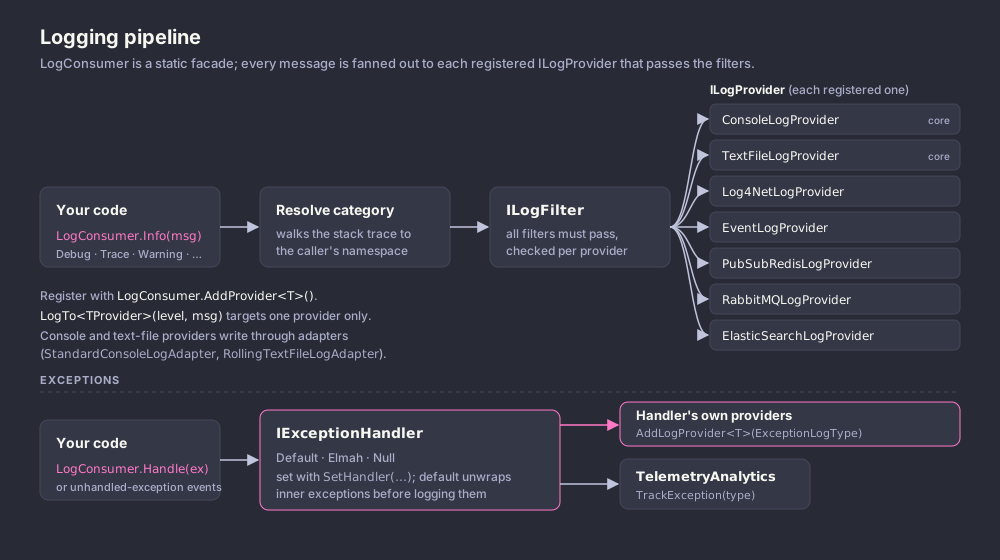
CrispyWaffle.Log4Net is a bridge that sends CrispyWaffle log calls to an Apache log4net logger. Use it when your application already configures log4net appenders and you want messages written through LogConsumer to go to the same destinations.
| Package | CrispyWaffle.Log4Net |
| Namespace | CrispyWaffle.Log4Net |
| Install | dotnet add package CrispyWaffle.Log4Net |
| Depends on | CrispyWaffle, log4net |
How it works
Log4NetLogProvider implements ILogProvider and wraps a log4net ILog. You configure log4net (appenders, layouts, thresholds) as usual, get an ILog from LogManager, and register the provider with LogConsumer.
The provider filters calls by its own CrispyWaffle LogLevel first. It starts with no level enabled, so call SetLevel after you register it. Calls that pass the filter go to the log4net method shown below. log4net then applies its own level thresholds.
| CrispyWaffle call | log4net call |
|---|---|
Fatal |
ILog.Fatal |
Error |
ILog.Error |
Warning |
ILog.Warn |
Info |
ILog.Info |
Trace (all overloads) |
ILog.Info |
Debug (all overloads) |
ILog.Debug |
The category argument is not forwarded; log4net uses the logger name of the ILog you pass in. Exceptions are not passed to log4net as exception objects. The provider writes the message and stack trace of the exception and of each inner exception as separate Info entries.
Getting started
using System.IO;
using System.Reflection;
using CrispyWaffle.Log;
using CrispyWaffle.Log4Net;
using log4net;
using log4net.Config;

var repository = LogManager.GetRepository(Assembly.GetEntryAssembly());
XmlConfigurator.Configure(repository, new FileInfo("log4net.config"));

var log = LogManager.GetLogger(typeof(Program));

LogConsumer.AddProvider(new Log4NetLogProvider(log)).SetLevel(LogLevel.All);

LogConsumer.Info("Application started");
Reference
Log4NetLogProvider
public sealed class Log4NetLogProvider : ILogProvider — log provider that writes to a log4net ILog.
| Member | Description |
|---|---|
Log4NetLogProvider(ILog adapter) |
Constructor. The argument is not checked for null. |
SetLevel(LogLevel level) |
Sets the enabled levels. Calls for levels that are not enabled are ignored. |
Fatal(category, message) |
Writes message with ILog.Fatal. |
Error(category, message) |
Writes message with ILog.Error. |
Warning(category, message) |
Writes message with ILog.Warn. |
Info(category, message) |
Writes message with ILog.Info. |
Trace(category, message) |
Writes message with ILog.Info. |
Trace(category, message, exception) |
Writes message, then the message and stack trace of exception and each inner exception, with ILog.Info. |
Trace(category, exception) |
Writes the message and stack trace of exception and each inner exception with ILog.Info. |
Debug(category, message) |
Writes message with ILog.Debug. |
Debug(category, content, identifier) |
Writes identifier, then content, as two ILog.Debug entries. |
Debug<T>(string category, T content, string identifier, SerializerFormat customFormat = SerializerFormat.None) |
Writes identifier, then content serialized with its [Serializer] format (or with customFormat when it is not None), as two ILog.Debug entries. T must be class, new(). |
Examples
Use a named logger and a narrower level
Only errors and fatal messages reach log4net.
using CrispyWaffle.Log;
using CrispyWaffle.Log4Net;
using log4net;

var provider = new Log4NetLogProvider(LogManager.GetLogger("CrispyWaffle"));
provider.SetLevel(LogLevel.Fatal | LogLevel.Error);
LogConsumer.AddProvider(provider);

LogConsumer.Error("Payment gateway returned {0}", 503);